Yangfeng Sweet Persimmon
Information provided by the client; listed in no particular order.
Variety & Origin
Yangfeng sweet persimmon (Diospyros kaki 'Yōhō') is a pollination-constant non-astringent (PCNA) cultivar of the persimmon family, native to Japan. It was bred in 1990 at the Akitsu Branch of the National Institute of Fruit Tree Science by crossing the Fuyu persimmon with the Jiro persimmon, and is regarded as one of the best all-round sweet persimmon varieties.
As a PCNA variety, Yangfeng completes its de-astringency naturally on the tree — the flesh is already crisp and sweet when the fruit is picked, with no artificial de-astringency needed. Simply rinse and eat. It eliminates the cumbersome de-astringency process required for astringent persimmons and excels at both fresh eating and commercial production.
The variety suits cultivation in the Yangtze River basin and on calcareous soils in Shaanxi, with an economic lifespan of 100–200 years — one investment, long-term returns.
Fruit Characteristics
The fruit is oblate (flattened round), with an average weight of 230 g and a maximum of 400 g — even, well-filled and satisfying to hold.
At maturity the skin turns orange-red with a deep red blush near the apex, brilliantly attractive. The flesh is orange-red, crisp and firm, sweet and refreshingly delicious; after storage it becomes dense and richly sweet.
Brix reaches 16 degrees with 18.4% soluble solids — exceptional quality. Grown alone the fruit is seedless; with a pollinizer tree, yield increases and seed numbers rise, so growers can flexibly match planting to fresh-market preferences.
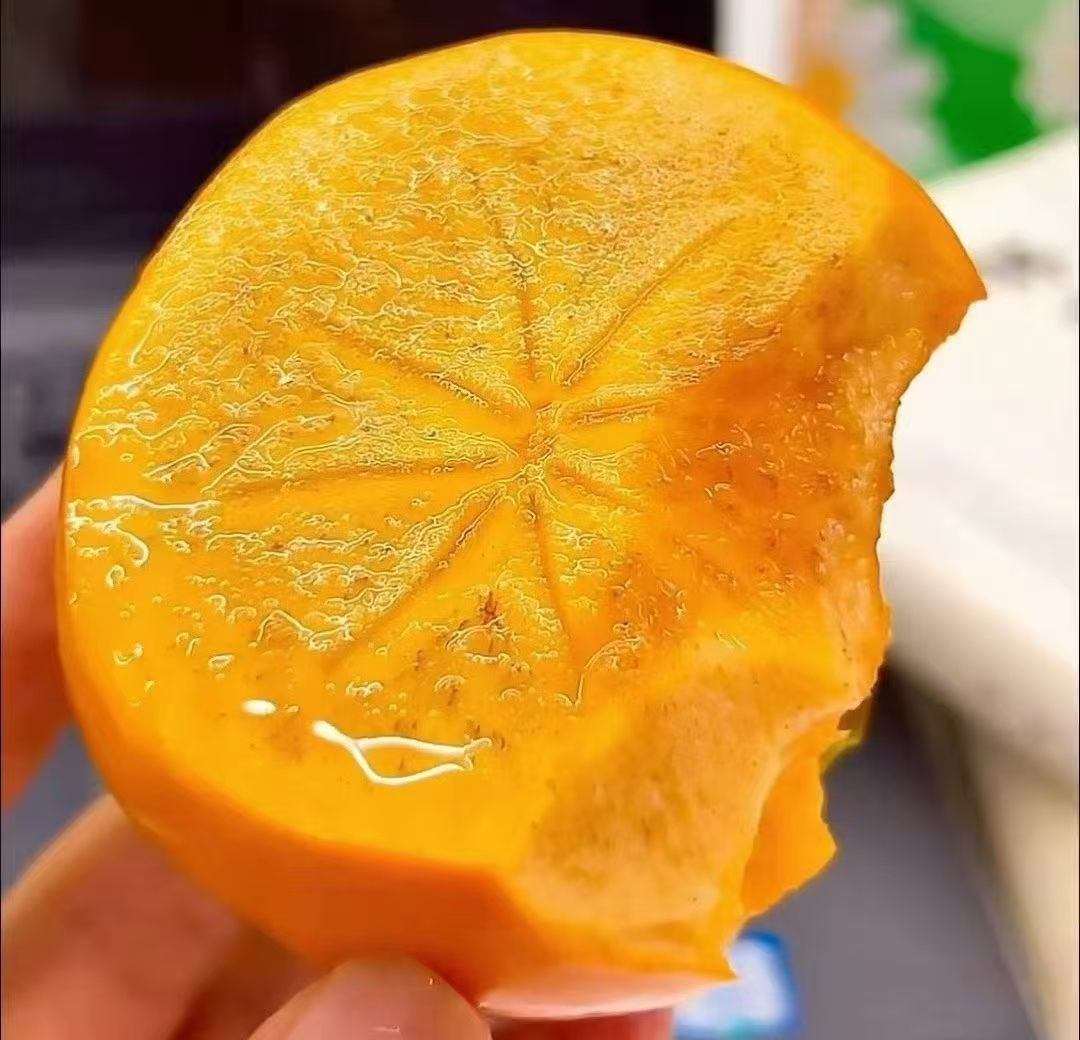
Maturity, Storage & Shipping
A mid-season variety timed for the National Day window: in Chongqing the fruit is edible from mid-to-late August, begins to color in early September and matures in mid-to-late September, and can hang on the tree until after the National Day holiday for even better flavour; in Shaanxi it matures in early-to-mid October.
During the crisp-firm stage it tolerates storage and shipping and does not crack — tough skin and firm flesh suit express delivery, gift boxes and long-distance distribution.
After about 20 days of natural storage the fruit softens, the flesh turning pasty and sticky with higher Brix and better flavour — enjoy it crisp or soft; two textures, two flavours, and a long sales window.
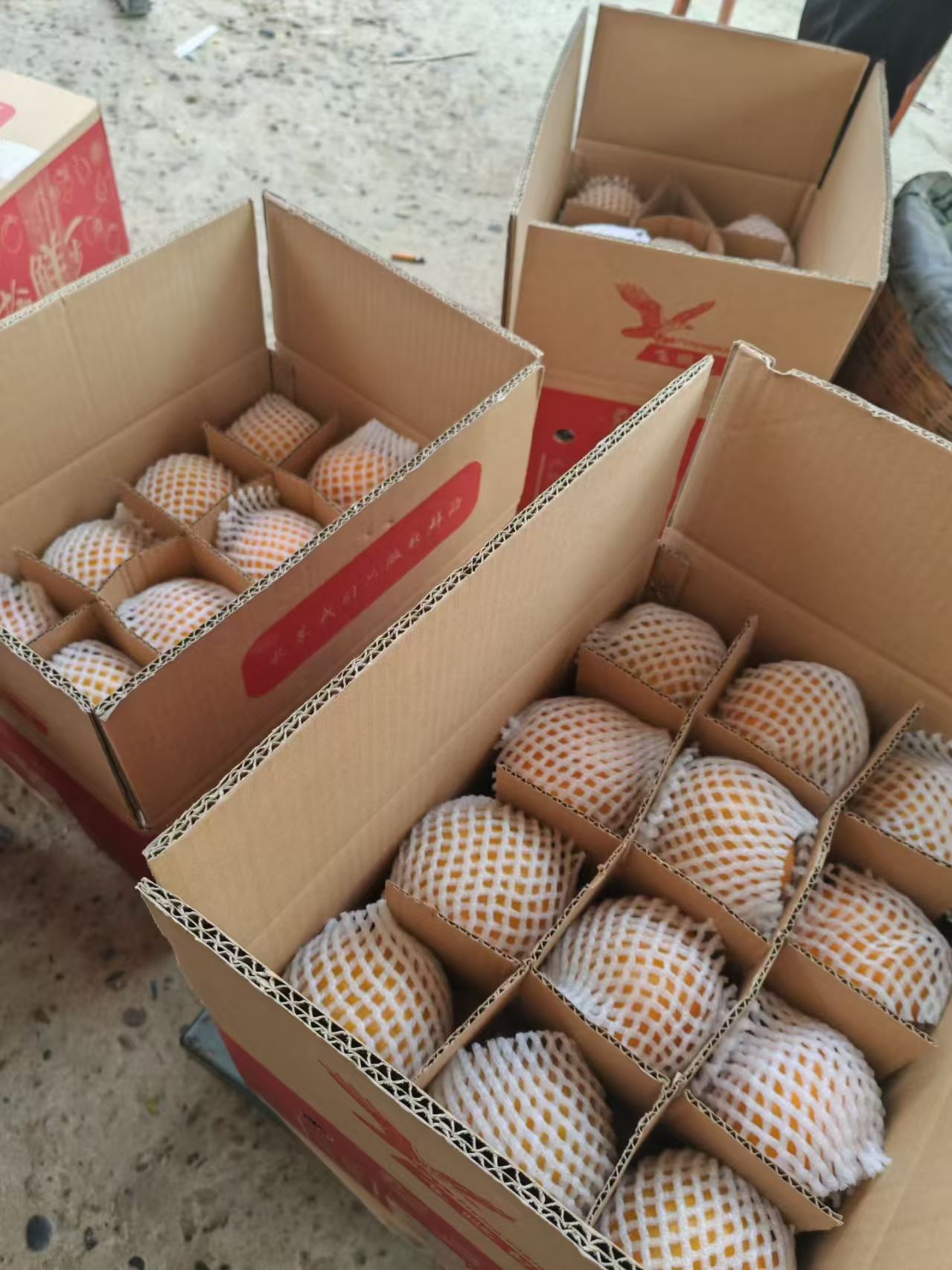
Cultivation Characteristics
Vigour is moderate with a fairly spreading habit; it flowers very easily and sets fruit exceptionally well — one of the finest-quality, highest-yielding sweet persimmon varieties.
In dense plantings (2.5 × 1.2 m, 222 trees per mu) trees bear fruit in the second year and enter full production in the fourth, with yields above 3,000 kg per mu — early returns and a short payback period.
Full-production orchards can sustain high yields for decades; well-managed orchards are stable producers, ideal for large-scale base planting.
Nutritional Value
Measurements by the Research Institute of Subtropical Forestry show that per 100 g of fresh flesh, sweet persimmon contains 22–24 g of soluble sugars (about 11.6 g in ordinary persimmon), 0.57–0.67 g of protein and 0.28–0.38 g of fat.
It is rich in niacin, vitamins B1, B2, E and C, and beta-carotene; the trace elements iron, zinc and selenium all exceed those of ordinary persimmon.
Compared with apple, it has about 13 times the sugar, 6 times the protein and 10 times the vitamin B; soluble solids run 14%–21%, and vitamin C, iron, zinc, calcium and selenium all exceed astringent persimmon, with a crisp-keeping period 2–3 times longer.
Product at a Glance
About the Grower · Xiaoyu Farm
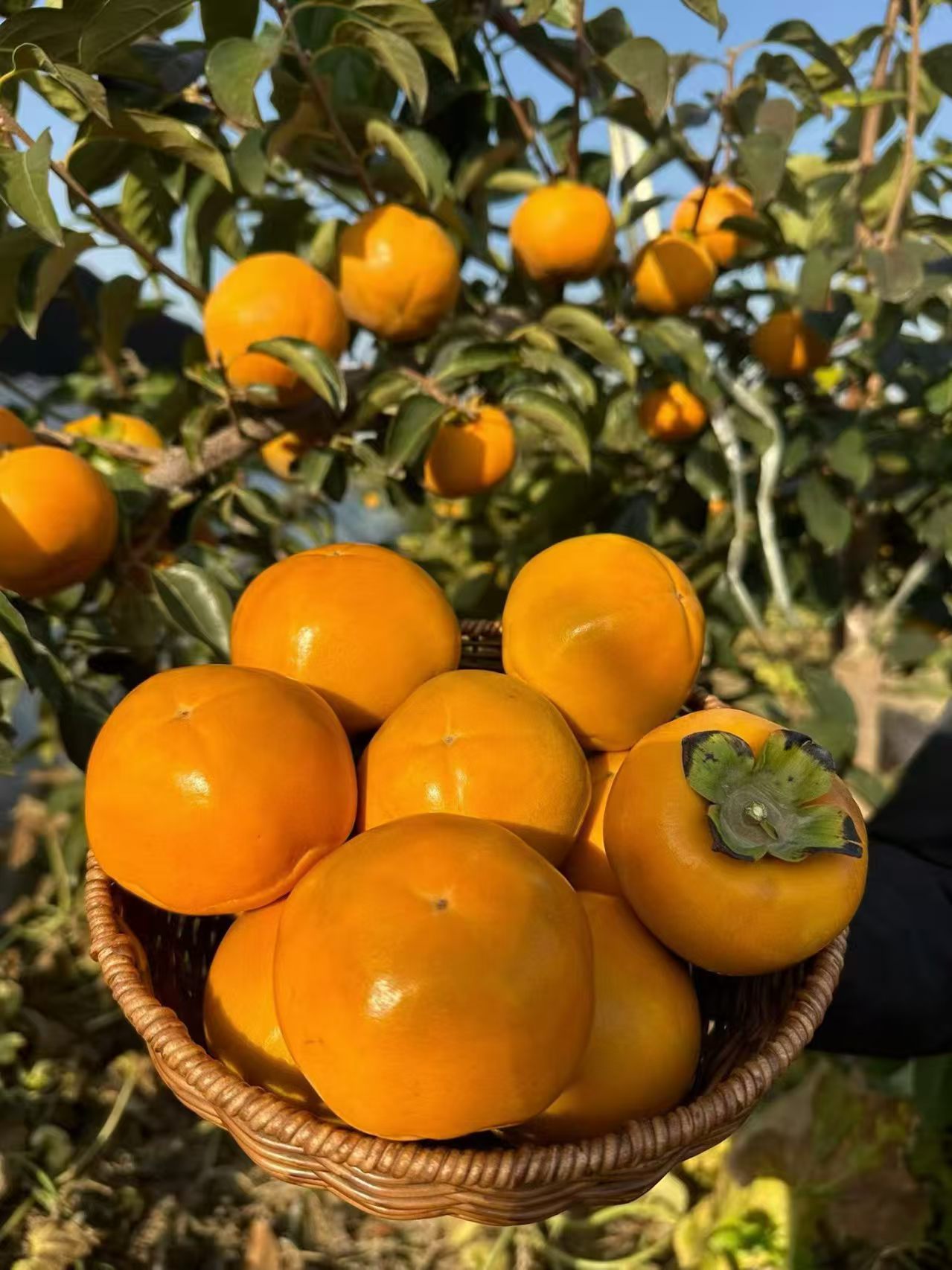
Xiaoyu Farm sits on a south-facing slope beside the Zhengguo Canal ruins in Jingyang County, Xianyang, Shaanxi — the Jing River to the south and the Beizhong Mountain to the north. The slope faces south with ample sunshine and large day-night temperature differences, and the soil is a loose, breathable sandy loam: the best possible environment for growing crisp persimmons. We have tended these fifty-odd mu for more than a decade without fuss, specializing in a single variety — Yangfeng crisp persimmon.
These persimmons are different from ordinary persimmons: they are eaten hard, straight from the tree. One bite and you hear a crunch — crisp, sweet and juicy, with not a trace of astringency. Loved by young and old alike.
Come for the blossoms in spring and the fruit in autumn — picked and shipped the same day, with attractive pricing for volume orders!
Which countries and regions have strong demand for fresh fruit and agri-food products? Visit the customer development map dashboard to see the global distribution of potential customers, or search the global prospect directory right here on the FangService website.
Want your company and products to be showcased here too, to step up your overseas expansion and win more international orders? Partner with FangService and enjoy going global together! Contact us.
Need a stable supply of Yangfeng sweet persimmon?
Tell us your target market, required specifications and estimated volume, and we will connect you with the Xiaoyu Farm orchard in Jingyang, Shaanxi, to confirm grading, packaging and logistics, with a quote within 24 hours.
Get a Free QuoteFrequently Asked Questions
Is Yangfeng an astringent or a sweet persimmon? Can it be eaten straight after picking?
Yangfeng is a pollination-constant non-astringent (PCNA) variety (Diospyros kaki 'Yōhō'), native to Japan, bred at the Akitsu Branch of the National Institute of Fruit Tree Science by crossing the Fuyu persimmon with the Jiro persimmon. In PCNA varieties de-astringency completes naturally on the tree, so the flesh is already crisp and sweet at harvest — no artificial de-astringency is needed; just rinse and eat.
When does Yangfeng sweet persimmon mature?
It is a mid-season variety: in Chongqing the fruit is edible from mid-to-late August and matures in mid-to-late September, hanging on the tree until after the National Day holiday; in Shaanxi it matures in early-to-mid October. Xiaoyu Farm in Jingyang, Shaanxi, typically enters its best harvest window in early-to-mid October.
How should the fruit be stored and shipped?
The crisp-firm stage tolerates storage and shipping without cracking, suiting express delivery and long-distance transport; after about 20 days of natural storage it softens, the flesh turning pasty and sweeter with better flavour — crisp or soft, both are a delight. Xiaoyu Farm ships express anywhere in China, with attractive pricing for volume orders from fruit distributors.
How can overseas buyers purchase?
Submit your purchasing requirements through FangService — target market, required specifications and estimated volume — and we will help connect you with the Xiaoyu Farm orchard in Jingyang, Shaanxi, confirm grading, packaging and logistics, and provide a quote and delivery schedule.