Article
October 8, 2019
Off-grid sites across northern Nigeria, Niger, Mali, Burkina Faso, Ethiopia and Turkana run on diesel, with fuel cost, transport and theft consuming much of the OPEX. This article covers the three topologies and when each applies, real battery life under daily cycling, the underrated dust variable, and a payback formula with four inputs you can measure on site.
A Day at an Off-Grid Site
Around Kano and Kaduna in northern Nigeria, in rural Niger, Mali and Burkina Faso, on the Ethiopian highlands, in Kenya's arid Turkana region and in Zambia's outlying provinces, a typical day runs like this: the diesel generator starts before dusk and runs into the night against a load of roughly 1 to 3kW; it shuts down overnight and the battery carries baseband and transmission; by day the battery continues to carry the site until evening, charging only if grid power happens to appear for a few hours. The problem is not the generator itself but three hidden costs: delivering fuel to site, which where motorcycle or camel transport is needed can exceed twice the pump price; fuel theft, which in some areas runs at 10% to 30% of purchased volume; and maintenance and overhaul amortised by running hour. The purpose of solar is not environmental — it is to move daytime load off the generator and cut all three costs directly.
Choosing Among Three Topologies
Solar hybrid is not one design but three, and choosing wrongly doubles the payback. The first is solar plus battery plus diesel standby, also called solar-priority: PV serves load and charges the battery by day, curtails once the battery is full, and diesel starts only after prolonged overcast or battery depletion. It minimises generator hours and suits sites with good annual irradiance and daytime-concentrated load — the most common choice in sub-Saharan Africa. The second is diesel-primary with solar assist, where PV carries only part of the load, typically 30% to 50%, and the generator runs as before at lower fuel consumption. Simplest to retrofit and cheapest in capital, it suits larger loads or sites with a relatively new generator. The third is pure solar plus battery with no generator at all, viable only where load is under 500W and three days of overcast risk is acceptable. The deciding factor across all three is not irradiance resource but how well the load curve overlaps the solar curve: high overlap favours the first, low overlap makes the second safer.
Real Battery Life Under Daily Cycling
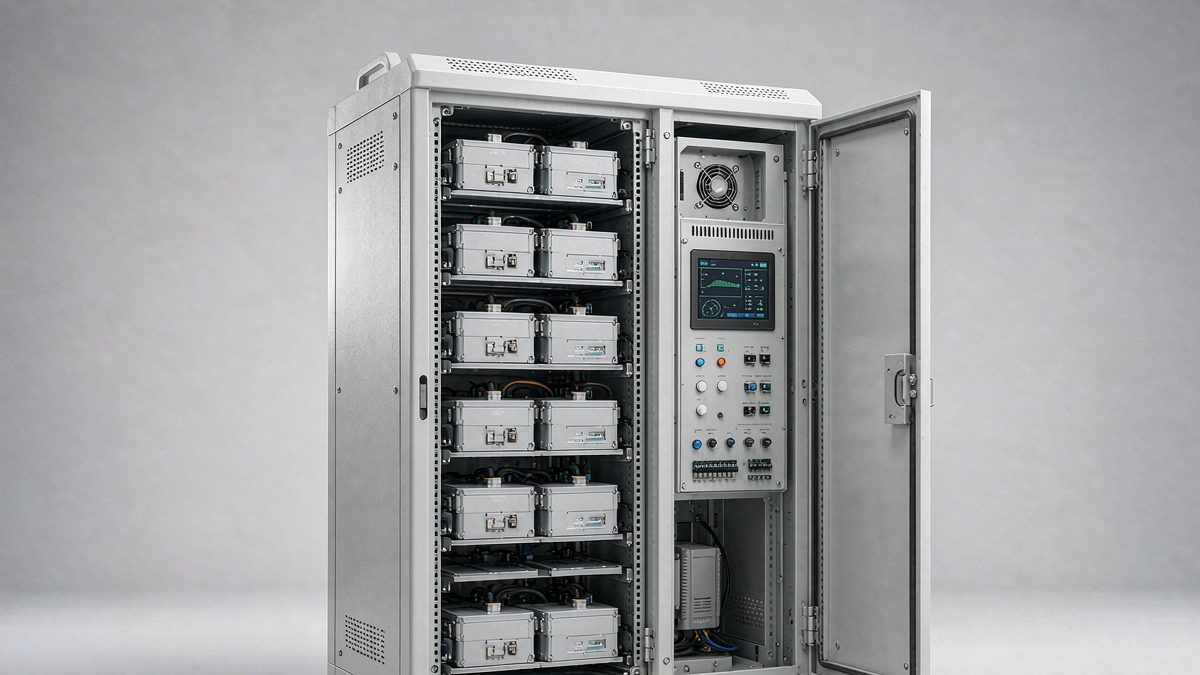
In a solar hybrid the battery completes a full cycle every day, which is nothing like float standby and is where many projects fail — they specify a float battery and replace it in two years. Selection depends on three figures, not on nameplate capacity. First, cycle life, and specifically cycle life at a stated depth of discharge; solar systems typically run at 50% to 70% DOD, so ask for data in that band. Second, charge acceptance: PV charging power varies with irradiance, current is low in the morning and late afternoon, and whether the battery can absorb effectively at low current determines daily energy recovery. The lead-carbon series (LLC, 300–1,000Ah, six models) delivers four to five times the cycle life of conventional product in PSoC duty with roughly 30% better charge acceptance, and is designed for exactly this. Third, high-temperature behaviour: cabinet temperatures above 40°C are routine in Africa, so cycle life must be corrected for temperature. The deep-cycle series (FTC, 100–170Ah, 1,500 cycles or more) is also a sound choice at small and medium capacity.
Dust: The Underrated Variable
Across the Sahel and arid East Africa, dust is badly underestimated. First, soiling: every layer of dust on the glass reduces transmittance by several percentage points, and after a dust storm the array may be covered thickly enough to halve output. In Niger, Mali and Chad, skipping cleaning can cost more than 20% of annual yield. Second, thermal: dust on the backsheet impedes heat rejection, raising cell temperature and cutting efficiency, compounding the loss. Third, mechanical and electrical: dust entering junction boxes and connectors causes poor contact and arc risk, and dust in inverter air paths blocks cooling. Four design responses follow: increase array tilt so dust is blown or washed off more readily; specify junction boxes and connectors with a higher ingress rating; use naturally cooled inverters or fit dust filters and add them to the inspection route; and put cleaning into the O&M contract with a defined frequency — monthly in dust season, quarterly otherwise — rather than 'as required'.

Calculating Payback
Payback needs no complex model, just four inputs, and all four can be measured on site. First, current annual diesel cost: average daily consumption in litres × 365 × delivered fuel price including transport. Use the delivered price, not the jetty price. Second, post-retrofit diesel cost: scale by the reduction in generator running hours, which for solar-priority designs is typically to 20% to 40% of the original. Third, annual PV yield: array capacity in kWp × local equivalent peak sun hours × 365 × system efficiency of 0.75 to 0.8 × soiling and degradation factor of 0.85 to 0.9. Fourth, total investment including modules, mounting, controller, battery, transport and installation. Payback = investment ÷ (pre-retrofit annual diesel cost − post-retrofit annual diesel cost − annual maintenance cost). The input most often overstated is the third: people use ideal sun hours and forget soiling and degradation. Take the conservative coefficients and the payback you calculate is one that can actually be delivered.
Sizing the Array and the Battery Together
The two most common errors in solar hybrid design are an undersized array and an undersized battery, and they usually occur together. The principle is to treat the overcast period as the constraint and daily energy balance as the objective, in three steps. First, daily consumption: load in kW × 24 hours, calculated separately where day and night loads differ. Second, average daily PV yield: array capacity in kWp × equivalent peak sun hours × system efficiency of 0.75 to 0.8 × soiling factor of 0.85. That result must exceed daily consumption, normally with 20% to 30% headroom to cover seasonal variation, module degradation and occasional shading. Third, battery capacity: daily consumption × overcast days ÷ depth of discharge, with overcast days taken from local weather records — two to three in the Sahel, one more on the East African highlands. After the three steps, run a reverse check: at the end of the longest overcast period, residual battery capacity should not fall below 20%, or generator starts will rise markedly and the hybrid's economics disappear. That check is frequently skipped, yet it is the only hard indicator of whether the ratio is sound. One further detail often missed is array tilt: in dusty regions, adding 5 to 10 degrees beyond the optimal generation tilt lets dust blow off more readily and yields more over time. View Telecom Backup Power Selection
Need a Custom Solution?
Tell us your project scenario and requirements, and we will match the right solution and provide a quote within 24 hours.
Get a Free QuoteView Telecom Base Station Backup Power Products
Nine series, sixty models: 12V front-terminal (6-FMX, 50–200Ah, 12-year), high-temperature (6-FMXH, 55°C with double float life), gel (6-XFMJ, 15-year), deep-cycle (FTC, 1,500+ cycles), 2V power station (GFD / GFM, 200–3,000Ah, 15-year), high-rate (GFMHR, 500W–2,700W at 15 min), lead-carbon (LLC, 300–1,000Ah, 20-year, 4–5× PSoC cycling) and 48V LiFePO4 (SDA10, 50–200Ah, continuous 1C). Intelligent BMS with SOC/SOH monitoring and four protection classes, with optional dry contacts for existing site monitoring systems.
Explore Backup Power Selection and Pricing →