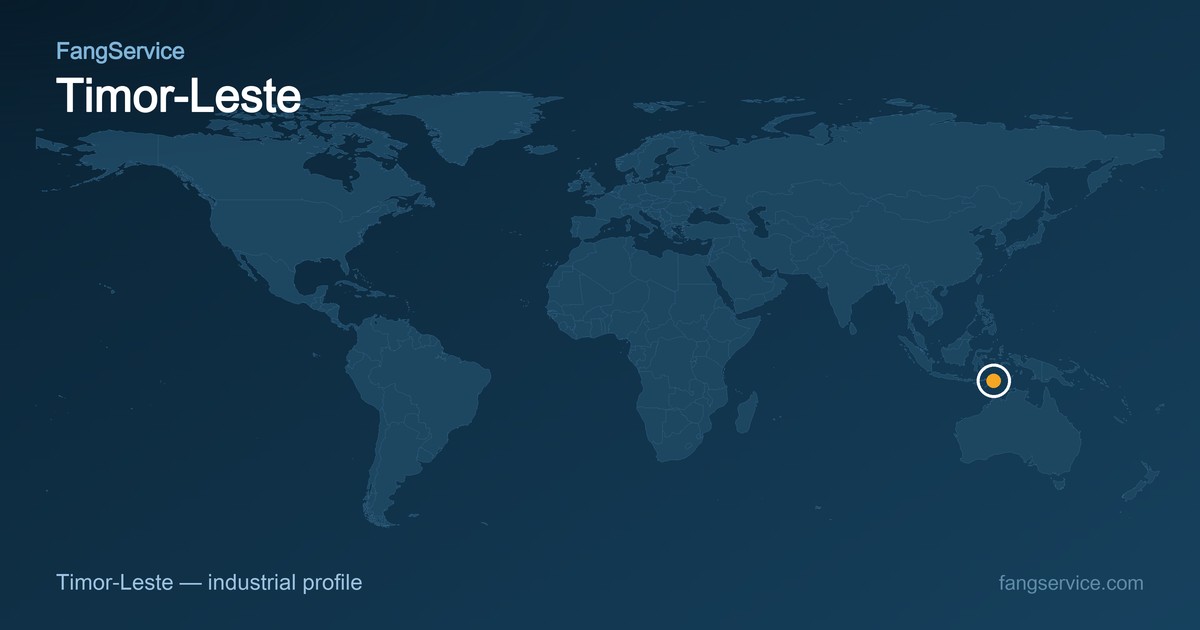
Industrial panorama
- World position by industrial production
- #189
- Industrial added value
- 2100M USD
- of which manufacturing industry
- 0100M USD
- Area
- 1.510,000 km²
- Population
- 14210,000 inhabitants.
- Official language
- Tetum, Portuguese
Main industrial sectors
Oil and gas
Revenues from the Bayu-Undan field in the Timor Sea, operated through the Bayu-Undan pipeline and the Suai supply base, financed most of the state's expenditure; the undeveloped Greater Sunrise field is the country's main economic hope, and oil and gas still dominate exports and the budget.
Coffee
Arabica coffee, grown by small farmers in the highlands around Ermera, Aileu and Maubisse, is Timor-Leste's main non-oil export and is sold as organic and fair trade beans to the United States, Germany, Japan and Australia; processing and milling capacity remains limited.
Construction and building materials
Roads, bridges, ports and public buildings are rebuilt with state oil revenues in Dili, Baucau and the districts, and construction is the largest non-oil employer; cement, steel, glass and most equipment are imported, mainly from Indonesia, China, Singapore and Portugal.
Agriculture and food processing
Rice, corn, cassava, and vegetables are grown in the lowlands, and food processing is limited to small mills, bakeries, and coffee hulling; The country imports most of its rice, sugar, flour and packaged foods, so agro-processing is a priority for diversification away from oil.
Fisheries and marine products
Coastal and artisanal fishing supplies local markets and a small export trade in tuna, sardines and seaweed, with landing and cold storage facilities in Dili, Com and Beaco; marine resources are underutilized and the government is looking for investors in processing and refrigeration.
Live Export Panel External
It aggregates official trade, industry, exchange, logistics and political signals. Sample data; linked to authorized sources and updated.
- Industrial added value (2024)
- 2 100 M USD
- of which manufacturing (2024)
- 0 100 M USD
- World industrial ranking
- #189
- Area
- 1.5 10 000 km²
- Population
- 142 10,000 inhabitants.
- Key sectors
- Oil and gas, Coffee, Construction and building materials, Agriculture and food processing, Fisheries and marine products
- Main commercial partners
- —
- Agreements signed
- —
- Key exchange rate
- —
- Latest policy/fee changes
- —
- Ports / logistics
- —
+Subscribe to official updates External
Target Market Opportunities Partner External
Organized by export journey and personalized recommendations; filter by industry/market. Scores and import data are samples, linked to official statistics and platforms.
🇺🇸 United States
🇪🇺 European Union
🌏 ASEAN
🇦🇪 Middle East
Buyer profiles · channel maps · deal benefits and rules of origin · competition — External: Access2Markets · OEC
Four Core Service Paths
Each path labeled: Own (FangService delivery) · Partner (referred/joint) · External (official/third party).
Compliance and Access
HS codes, tariffs, certification, origin, tax models
- HS code/fare calculation (WTO Tariff Base)External
- Export Control/Sanctions ScreeningExternal
- Market certification (CE/FDA/ISO…) translation and agencyOwnPartner
- Compliance templates (invoice/packaging/cert. of origin)Own
- VAT/GST/refund consultationExternal
Logistics and Customs
Ports/rail/air, rates and transit, freight forwarder directory
- Timetables/freight/freight rateExternal
- Documents and customs clearance processOwn
- Freight forwarders/dispatchers/local insurancePartner
- Warehouse / cold chain / returnsPartner
- China-Europe Railway / Multimodal TrackingExternal
Finance / Payments / Taxes
Cross-border payment, insurance, FX hedging, refunds
- Cross-border receipt/credit/factoringPartner
- Export Credit Insurance/Refund GuideExternal
- FX Hedge/SettlementExternal
- Total cost estimator tariff+logistics+taxExternal
Marketing and Acquisition
Ads, SEO, localized content, buyer directories
- Directory of prospects abroadOwn
- Google/LinkedIn/TikTok CampaignsPartner
- Localized texts/software UI localizationOwn
- Fairs / B2B matching / KOLPartner
- Recruitment of distributors and fair calendarExternal
Tools and Data External
Basic version without login; save results and reports after login. Tariff/HS/ROI/import/API link to official or third-party sources.
Fare Calculator External
Enter HS + country for estimated fare
HS code search External
Catalog and HS Classification
Compliance List Own
Generate list by country
Market entry evaluator External
Multidimensional data and scoring
ROI/cost estimator External
Total cost tariff+tax
Export document generator Own
Invoice/packaging/certification models. origin
Import data by country External
Import statistics and structure
Fair calendar External
Global agenda of sector fairs
API/Data Subscription External
Official data interface
Content, Learning and Community Partner External
Local peer cases
Sample · to be confirmed
Customer testimonials
Sample · to be confirmed
Recommended by Globalization Stage
Take your products to the world
State your target market and industry; FangService prepares a tailored globalization plan.
Free diagnosis / Schedule an appointment →Explore FangService
FAQ
What are the most important industrial sectors in Timor-Leste?
The most important industrial sectors in Timor-Leste are: Oil and gas, Coffee, Construction and building materials, Agriculture and food processing, Fishing and marine products.
What are the main opportunities for companies in Timor-Leste?
Industry in Timor-Leste is based on Oil and gas, Coffee, Construction and building materials, Agriculture and food processing, Fishing and marine products; local companies can build on these strengths to capture domestic and regional demand.
Where does this data come from and how often is it updated?
The data comes from the World Bank's World Development Indicators (2024 edition, updated in ) and is renewed annually.
What are the main challenges of the industrial sector in Timor-Leste?
As in many economies, Timor-Leste seeks to deepen the added value of the manufacturing industry and regional integration; details vary by industry.
Source: World Bank, World Development Indicators (2024 data, updated in ). Industrial value added = mining + manufacturing industry + electricity/gas/water + construction, in current dollars. Last updated:2026-10-14