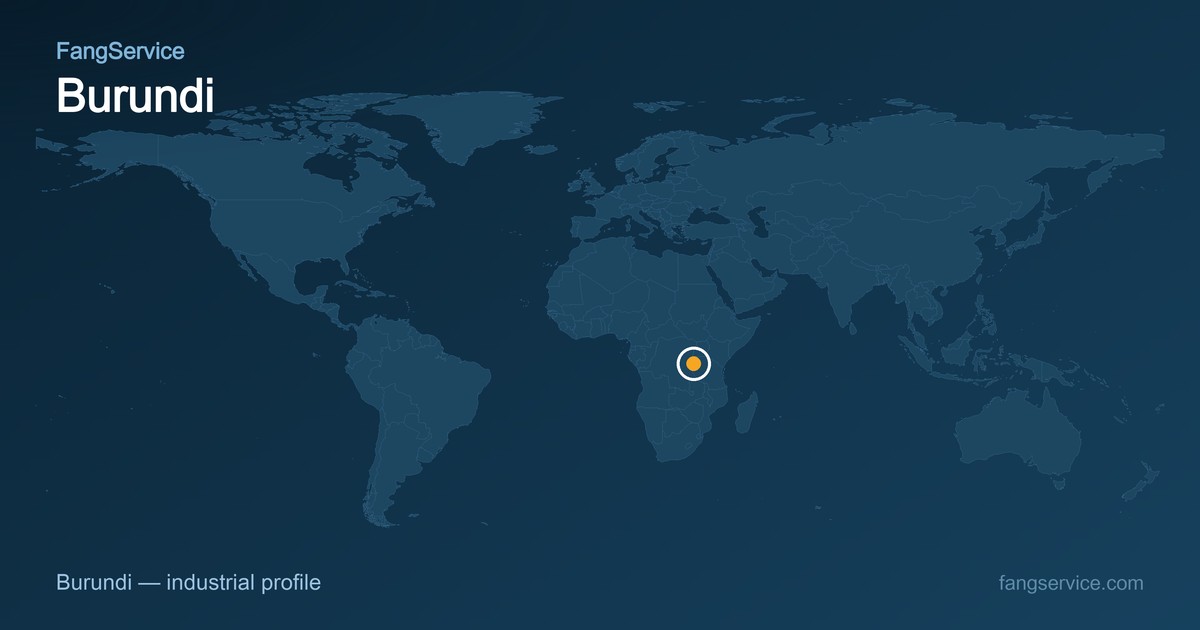
Industrial Overview
- World rank by industrial production
- #172
- Industrial added value
- 6100M USD
- including manufacturing industry
- 4100M USD
- Area
- 2.810,000 km²
- Population
- 1,43910,000 inhabitants.
- Official language
- Kirundi, French
Main industrial sectors
Coffee
Coffee is Burundi's main export crop, grown mainly by smallholders in the highlands of Kayanza, Ngozi and Kirundo in the north; Washed Arabica beans are shipped to Europe and North America, and their cultivation supports most rural livelihoods.
Tea
Tea is the second pillar of the agricultural export economy, grown on smallholder estates and small plots around Teza, Tora and Ijenda in the highlands; Most green and black tea is exported via Mombasa and Dar es Salaam to European and Asian buyers.
Cement and building materials
Cement production, driven by the Bujumbura factory and clinker imports from the port, supplies a construction sector concentrated in Bujumbura and Gitega; Rapid urban construction and donor-funded road and hydropower projects are keeping demand for cement, steel and aggregates firm.
Beverages and Food Processing: Brewing and bottling of soft drinks, centered on Brarudi's factories in Bujumbura and Gitega, as well as processing of edible oils, sugar and dairy products, constitute the bulk of the formal manufacturing industry and supply domestic consumers, with limited exports to neighboring Rwanda, Tanzania and the DRC.
Mines and minerals: Coltan, cassiterite and gold are mined artisanally and semi-industrially in the northwest around Kayanza and Cibitoke; Deposits of tungsten and rare earths remain largely unexploited and the government is courting investors to formalize and industrialize the sector.
Live Export Dashboard External
Aggregates official trade, industry, foreign exchange, logistics and political signals. Example data; linked to authorized sources and updated.
- Industrial added value (2025)
- USD 6,100 million
- of which manufacturing (2025)
- USD 4,100 million
- Global industrial rank
- #172
- Area
- 2.8 10,000 km²
- Population
- 1,439 10,000 inhabitants.
- Key sectors
- Coffee, Tea, Cement and Building Materials, Beverages and Food Processing: Brewing and bottling of soft drinks, centered on Brarudi's factories in Bujumbura and Gitega, as well as processing of edible oils, sugar and dairy products, constitute the bulk of the formal manufacturing industry and supply domestic consumers, with limited exports to Rwanda, Tanzania and the Neighboring DRC., Mines and minerals: Coltan, cassiterite and gold are extracted artisanally and semi-industrially in the northwest around Kayanza and Cibitoke; Deposits of tungsten and rare earths remain largely unexploited and the government is courting investors to formalize and industrialize the sector.
- Main trading partners
- —
- FTAs signed
- —
- Key exchange rate
- —
- Latest policy/price changes
- —
- Ports/logistics
- —
+S'subscribe to official updates External
Target Market Opportunities Partner External
Organized by export journey and personalized recommendations; Filter by industry/market. Scores and import data are examples, linked to official statistics and platforms.
🇺🇸 United States
🇪🇺 European Union
🌏 ASEAN
🇦🇪 Middle East
Buyer profiles · channel maps · FTA benefits and rules of origin · competition — External: Access2Markets · OEC
Four Key Service Journeys
Each route labeled: Own (FangService book) · Partner (referred/spouse) · External (official/third party).
Compliance and Access
HS codes, prices, certification, origin, tax models
- HS code / rate calculation (WTO Rate Base)External
- Export control / sanctions screeningExternal
- Market certification (CE/FDA/ISO…) translation and agencyOwnPartner
- Conformity models (invoice/packaging/certificate of origin)Own
- VAT/GST/reimbursement searchExternal
Logistics and Customs
Ports/rail/air, rates and transit, forwarder directory
- Schedules / freight / freight indexExternal
- Customs clearance documents and processesOwn
- Local freight forwarders/brokers/insurancePartner
- Warehouses / cold chain / returnsPartner
- China-Europe rail / multimodal trackingExternal
Finance / Payments / Taxes
Cross-border payment, insurance, FX coverage, refunds
- Cross-border collection / credit / factoringPartner
- Export credit insurance / reimbursement guideExternal
- FX Hedging/SettlementExternal
- Estimated total cost price+logistics+taxExternal
Marketing and Acquisition
Advertisements, SEO, localized content, buyer directories
- Directory of prospects abroadOwn
- Google/LinkedIn/TikTok campaignsPartner
- Localized copies / software UI localizationOwn
- Trade shows / B2B matching / KOLPartner
- Distributor recruitment and trade show calendarExternal
Tools and Data External
Basic version without connection; save results and reports after connection. Pricing/HS/ROI/import/API link to official or third-party sources.
Rate calculator External
Enter HS + country for estimated price
HS code search External
HS catalog and classification
Compliance List Own
Generate list by country
Market Entry Evaluator External
Multidimensional data and score
ROI / cost estimator External
Total cost tariff+tax
Export document generator Own
Invoice/packaging/certificate models. origin
Import data by country External
Import statistics and structure
Exhibition calendar External
Global agenda of sectoral exhibitions
API / data subscription External
Official data interface
Content, Learning and Community Partner External
Local peer cases
Example · to be confirmed
Customer testimonials
Example · to be confirmed
Recommended by expansion stage
Take your products to the world
Indicate your target market and industry; FangService develops a tailor-made expansion plan.
Free diagnosis / Book a consultation →Explore FangService
FAQs
What are the most important industrial sectors in Burundi?
The most important industrial sectors in Burundi are: Coffee, Tea, Cement and construction materials, Beverages and food processing: Brewing and bottling of soft drinks, centered on Brarudi's factories in Bujumbura and Gitega, as well as the processing of edible oils, sugar and dairy products, constitute the bulk of the formal manufacturing industry and supply domestic consumers, with limited exports to neighboring Rwanda, Tanzania and the DRC., Mines and minerals: Coltan, cassiterite and gold are mined artisanally and semi-industrially in the northwest around Kayanza and Cibitoke; Deposits of tungsten and rare earths remain largely unexploited and the government is courting investors to formalize and industrialize the sector.
What are the main opportunities for businesses in Burundi?
The industry in Burundi relies on Coffee, Tea, Cement and construction materials, Beverages and food processing: Brewing and bottling of soft drinks, centered on the Brarudi factories in Bujumbura and Gitega, as well as the processing of edible oils, sugar and dairy products, constitute the bulk of the industry. formal manufacturing and supply domestic consumers, with limited exports to neighboring Rwanda, Tanzania and the DRC., Mines and Minerals: Coltan, cassiterite and gold are mined artisanally and semi-industrially in the northwest around Kayanza and Cibitoke; Deposits of tungsten and rare earths remain largely unexploited and the government is courting investors to formalize and industrialize the sector. ; local businesses can capitalize on these assets to meet domestic and regional demand.
'Where does this data come from and how often is it updated?
Data comes from the World Bank's World Development Indicators (2025 edition, updated), updated annually.
What are the main challenges of the industrial sector in Burundi?
Like many economies, Burundi seeks to deepen manufacturing value added and regional integration; details vary depending on the sector.
Source: World Bank, World Development Indicators (2025 data, updated). Industrial value added = mining + manufacturing + electricity/gas/water + construction, in current dollars. Last updated:2026-10-14