Article
September 27, 2023
5G AAUs draw far more than 4G RRUs, so a four-hour backup designed for 4G may deliver only ninety minutes at a 5G site. This article gives the correct runtime calculation with temperature and ageing corrections, separates the high-rate and high-capacity technology routes, and sets out a three-step retrofit path.
The Power Profile Has Changed
Large-scale 5G deployment in Singapore, Malaysia, Thailand, the Philippines, Vietnam and Indonesia concentrated in 2021 to 2023, while backup capacity at many sites was sized for the 4G era. The problem is structural. A typical three-sector 4G site — baseband unit plus three RRUs — draws roughly 800W to 1,200W. A three-sector 5G site with a baseband unit and three AAUs typically draws 2,000W to 3,500W, and peak demand climbs further with massive MIMO beamforming and wider bandwidth. The change is not linear but structural: AAUs integrate radio and antenna, the power amplifier sits up on the tower where thermal conditions are worse than in the equipment room, and consumption rises further in heat. The consequence is that the same battery string that carried a 4G site for four hours carries a 5G site for only ninety minutes to two hours — at precisely the sites now carrying more critical traffic, where an outage costs more than it did in the 4G era.
Calculating Runtime Correctly
Runtime is not a figure you can read off a datasheet; it must be calculated. The basic formula is: runtime in hours = usable battery capacity in kWh × depth of discharge × temperature correction × ageing correction ÷ average site load in kW. Four things commonly go wrong. First, usable capacity must be capacity at the actual discharge rate, not the ten-hour rating — the higher the rate, the lower the delivered capacity. Second, depth of discharge cannot be 100%; lead-acid is normally designed at 60% to 80%, and taking 100% collapses cycle life. Third, temperature correction: at 45°C the energy a battery can actually deliver falls below its rating, while the same heat accelerates ageing — two effects stacking. Fourth, ageing correction: end-of-life capacity may be only 80% of initial, so a backup sized on new-battery capacity fails its target in year three. Recalculated with all four factors, the true runtime at many 5G sites is about half the nameplate figure — and that is the number to plan against.
High Rate versus High Capacity: Two Different Problems
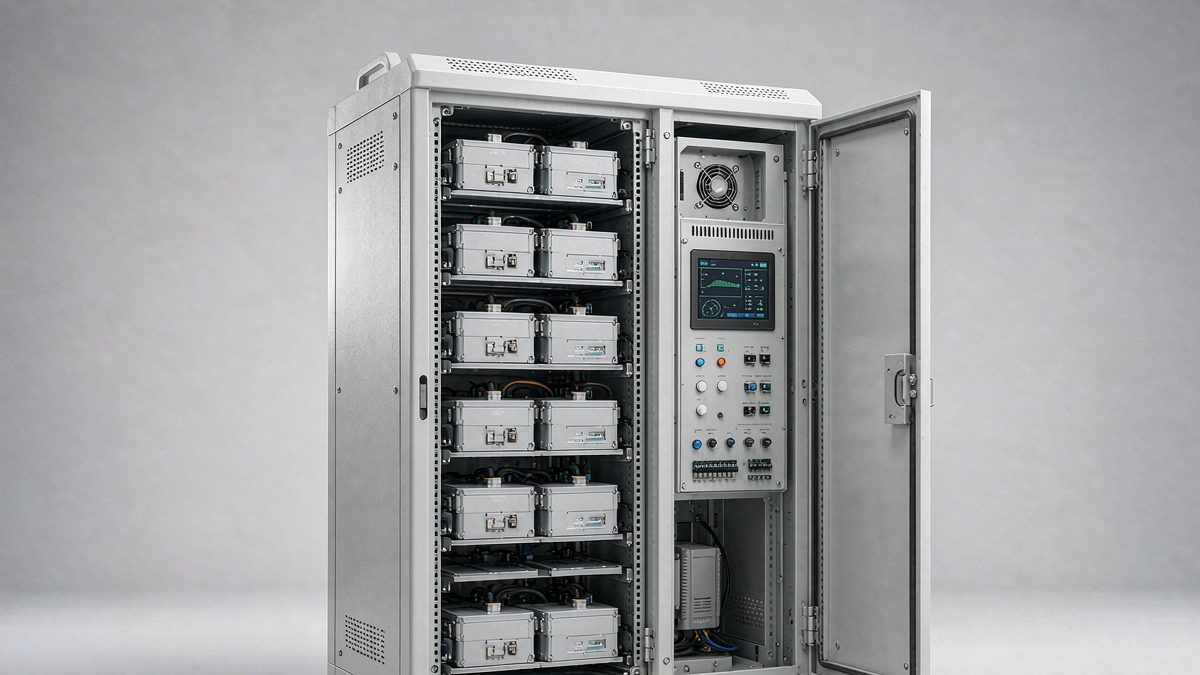
There are two technology routes to more runtime, they solve different problems, and mixing them wastes money. The high-rate route uses batteries able to deliver large current in a short window — for example the 2V high-rate series (GFMHR, 500W to 2,700W rated at fifteen minutes, nineteen models, twelve-year design life). Its value is short-duration high current: where site load is 3kW and backup needs to cover under an hour, high-rate cells meet the duty with fewer units and less footprint. The high-capacity route uses standard 2V cells (GFM, 200–3,000Ah, fifteen-year design life) or 12V front-terminal monoblocs and builds runtime from capacity; it suits sites needing four hours or more at relatively stable load. The test is simple: multiply load in kW by target hours; if the resulting discharge rate exceeds 1C, take the high-rate route; if it is below 0.3C, high capacity is more economical. In between, either works and the comparison is footprint against cost.
A Three-Step Retrofit
Upgrading backup at existing 4G sites for 5G can be done in three steps rather than a single replacement programme. Step one is measure before calculating: install a power logger at the site, record seven days of load profile, take peak and mean, and apply the formula above to get true runtime. This alone screens out a meaningful share of sites that are in fact still adequate — many 4G sites were originally over-provisioned. Step two is release before replace: at sites genuinely short, first recover capacity at low cost by relaxing depth of discharge from a conservative 50% to 70% where cycle count permits, cleaning terminal contact resistance, and reducing cabinet temperature. These measures often release 20% to 30% of effective capacity. Step three is expand to the measured gap: add a parallel string where the gap is under 50%, and replace the string with a fresh calculation where it exceeds 50%. Spread this way, capital spend falls across two or three financial years and every increment is backed by measured data.

Tiered Backup: Spend Where It Matters
The one thing not to do in the 5G era is give every site the same runtime. Tier the estate instead. Group sites into three classes: Class A covers core nodes, transmission aggregation points and sites carrying enterprise private lines or emergency communications, targeted at eight hours or more with remote monitoring and a generator interface; Class B covers urban macro sites and important transport corridors at four hours; Class C covers suburban, rural and low-traffic sites at two hours, where the objective is to survive until a crew arrives rather than until the grid returns. Tiering lets the same budget cover more sites. In Indonesian and Philippine conditions, cutting Class C backup from eight hours to two frees enough battery capacity to double Class A, and network-weighted availability rises. The prerequisite is a clean site list with service tiers — no technical difficulty, but it requires operations, planning and procurement to agree on definitions.
Calculating the Return on a Retrofit
Backup power retrofits are the first item cut in a budget meeting, because the proposal cannot state a return. A return can be calculated, and directly. There are three benefit streams. First, avoided outage loss, equal to the reduction in outage count × loss per outage, where loss per outage can be estimated as affected subscribers × duration × compensation per unit of time — a figure already written down under an SLA, not a guess. Second, avoided battery replacement cost, from the difference in replacement count over eight years, each including battery price, transport, labour and disposal. Third, avoided site visit cost, from the difference in inspection frequency × cost per visit. On the cost side sit retrofit capital and incremental annual maintenance. Discount the three benefit streams to a common year at one rate and compare with the investment to obtain payback. In practice Class A sites typically pay back in two to four years, Class B in four to six, and Class C may exceed eight — which is precisely why tiering matters. Not every site is worth retrofitting, but for those that are, the return is calculable. Put the calculation in the business case and it persuades finance far better than any technical argument, because it translates 'buy a bigger battery' into 'this is when the money comes back'. View Telecom Backup Power Selection
Need a Custom Solution?
Tell us your project scenario and requirements, and we will match the right solution and provide a quote within 24 hours.
Get a Free QuoteView Telecom Base Station Backup Power Products
Nine series, sixty models: 12V front-terminal (6-FMX, 50–200Ah, 12-year), high-temperature (6-FMXH, 55°C with double float life), gel (6-XFMJ, 15-year), deep-cycle (FTC, 1,500+ cycles), 2V power station (GFD / GFM, 200–3,000Ah, 15-year), high-rate (GFMHR, 500W–2,700W at 15 min), lead-carbon (LLC, 300–1,000Ah, 20-year, 4–5× PSoC cycling) and 48V LiFePO4 (SDA10, 50–200Ah, continuous 1C). Intelligent BMS with SOC/SOH monitoring and four protection classes, with optional dry contacts for existing site monitoring systems.
Explore Backup Power Selection and Pricing →