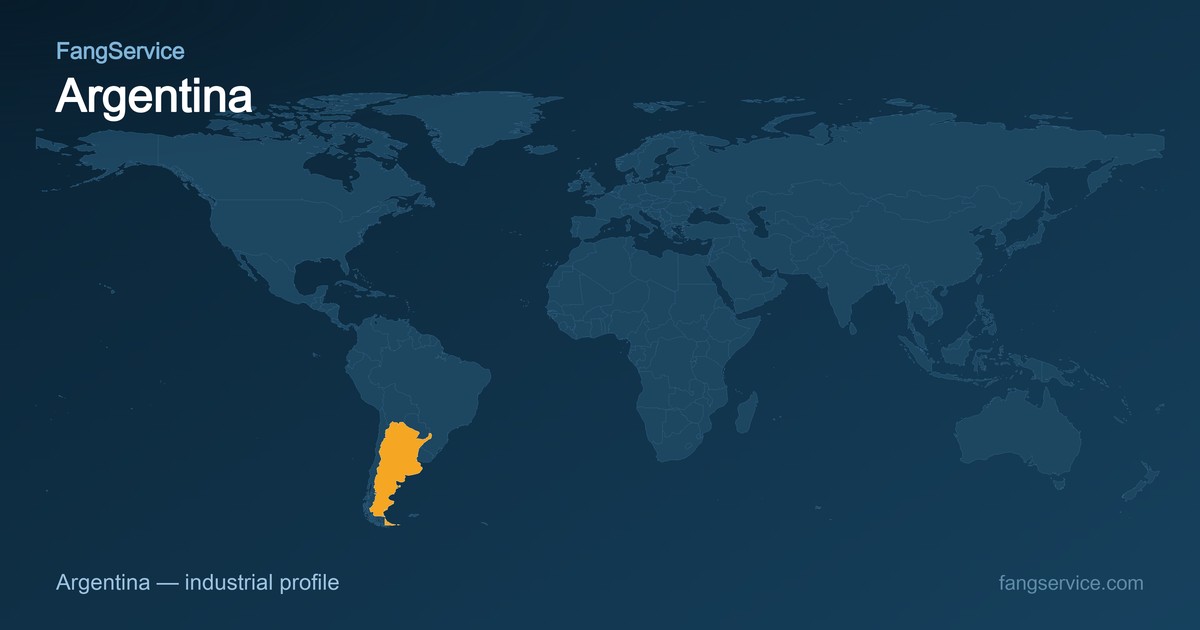
Industrial Overview
- World Rank by Industrial Output
- #28
- Industrial Value Added
- 1,563USD 100M
- of which Manufacturing
- 927.9USD 100M
- Land Area
- 278.010,000 km²
- Population
- 4,58510,000 people
- Official Language
- Spanish
Key Industrial Sectors
Automotive assembly and auto parts
Vehicle and component plants cluster in Cordoba, Greater Buenos Aires (General Pacheco, Escobar) and Santa Fe, where Toyota, Ford, Volkswagen and Stellantis build pickups and cars for both domestic and export markets.
Food and beverage processing
Beef packing, soybean crushing and biodiesel, wine from Mendoza and San Juan, dairy, and yerba mate milling make food processing the single largest manufacturing block by employment.
Steel, aluminium and metalworking
Ternium and Tenaris at San Nicolas and Campana, and Aluar aluminium smelting at Puerto Madryn, anchor the metals chain alongside a dense agricultural-machinery cluster in Santa Fe and Cordoba.
Chemicals and petrochemicals
YPF and Pampa Energia operate refining and petrochemical complexes at Bahia Blanca, Ensenada and Campana, supplying plastics, fertilisers and industrial chemicals to regional industry.
Cement and construction materials
Cement, concrete and aggregate producers serve public infrastructure and private construction cycles concentrated in the Buenos Aires metropolitan region and the Pampas corridor.
National Export Live Dashboard External
Aggregating official trade, industrial, FX, logistics and policy signals. Sample data; linked to authoritative sources and updated.
- Industrial value added (2025)
- 1,563 USD 100M
- of which manufacturing (2025)
- 927.9 USD 100M
- Global industrial output rank
- #28
- Land area
- 278.0 10,000 km²
- Population
- 4,585 10,000 people
- Key industrial sectors
- Automotive assembly and auto parts, Food and beverage processing, Steel, aluminium and metalworking, Chemicals and petrochemicals, Cement and construction materials
- Top trade partners
- —
- FTAs signed
- —
- Key exchange rate
- … · …
- Latest policy / tariff changes
- —
- Ports / logistics status
- —
+ Subscribe to official data updates External
Target Market Opportunities Partner External
Organized by export journey and personalized recommendations; filter by industry / target market. Scores and import data are samples, linked to official import statistics and platforms.
🇺🇸 United States
🇪🇺 European Union
🌏 ASEAN
🇦🇪 Middle East
Buyer profiles · channel maps · FTA benefits & rules of origin · competitive landscape — External: Access2Markets · OEC
Four Core Service Paths
Each path is tagged: In-house (FangService delivers) · Partner (referred/joint) · External (official/3rd-party).
Compliance & Market Access
HS codes, tariffs, certification, origin, tax templates
- HS code / tariff calculator (WTO Tariff Database)External
- Export control / sanctions screeningExternal
- Target-market certification (CE/FDA/ISO…) translation & agencyIn-housePartner
- Compliance templates (invoice/packing/COO)In-house
- VAT/GST/refund policy lookupExternal
Logistics & Customs
Ports/rail/air, freight rates & transit, forwarder directory
- Sailing schedules / freight / freight indexExternal
- Customs clearance docs & process guidanceIn-house
- Local forwarders / brokers / insurance directoryPartner
- Warehousing / cold-chain / returnsPartner
- China-Europe rail / multimodal trackingExternal
Finance / Payments / Tax
Cross-border payment, insurance, FX hedge, rebates
- Cross-border collection / L/C / factoringPartner
- Export credit insurance / rebate guideExternal
- FX hedging / settlementExternal
- Tariff+logistics+tax total cost estimatorExternal
Marketing & Acquisition
Ads, SEO, localized content, buyer directories
- Overseas prospect directoryIn-house
- Google/LinkedIn/TikTok campaignsPartner
- Localized copy / software UI localizationIn-house
- Trade shows / B2B matchmaking / KOLPartner
- Distributor recruitment & global expo calendarExternal
Tools & Data External
Basic version is login-free; save results and generate reports after login. Tariff/HS/ROI/import data/API link to official or third-party authoritative sources.
Tariff calculator External
Enter HS + target country for estimated tariff
HS code lookup External
Search HS directory & classification
Compliance checklist In-house
Generate go-global compliance checklist by country
Market entry scorer External
Multi-dimensional market data & scoring
ROI / cost estimator External
Tariff + tax total cost
Export document generator In-house
Invoice/packing/COO template download
Target-country import data External
Import statistics & structure by country
Expo calendar External
Global industry trade-show schedule
API / data subscription External
Official data publishing interface
Content, Learning & Community Partner External
Local peer cases
Sample · to be confirmed
Client testimonials
Sample · to be confirmed
Recommended by Go-Global Stage
Take your products global
Tell us your target market and industry; FangService builds a customized go-global plan.
Free diagnosis / Book a consult →Explore FangService
FAQ
What are the most important industrial sectors in Argentina?
The most important industrial sectors in Argentina are: Automotive assembly and auto parts, Food and beverage processing, Steel, aluminium and metalworking, Chemicals and petrochemicals, Cement and construction materials.
What are the main opportunities for businesses in Argentina?
Argentina's industry centers on Automotive assembly and auto parts, Food and beverage processing, Steel, aluminium and metalworking, Chemicals and petrochemicals, Cement and construction materials; local businesses can build on these strengths to capture domestic and regional demand.
Where does this data come from and how often is it updated?
Data comes from the World Bank World Development Indicators, 2025 vintage, refreshed annually.
What are the main challenges facing Argentina's industrial sector?
Like many economies, Argentina aims to deepen manufacturing value-add and regional integration; specifics vary by sector.
Source: World Bank World Development Indicators (2025 vintage). Industrial value added = mining + manufacturing + electricity/gas/water + construction, in current USD. Last updated:2026-10-12
Base Station Backup Power: Lead-Acid Battery Series
A few seconds without power and a base station starts dropping sessions. We have put together five articles on telecom base station lead-acid backup batteries — why backup is mandatory, float/equalize charging and capacity design, outdoor cabinets and high temperature, operator selection and large-scale deployment.
- Why Telecom Base Stations Cannot Do Without Lead-Acid Battery Backup
- Float, Equalize and Capacity Design: Three Essentials for Base Station Lead-Acid Strings
- Outdoor Cabinets and High Temperature: Environmental Tolerance of Base Station Lead-Acids
- From Selection to Large-Scale Deployment: How Telecom Operators Choose Base Station Backup
- Lead-Acid vs Lithium: How to Choose Base Station Backup Power