Country market · entry brief

Exporting to Macao, China

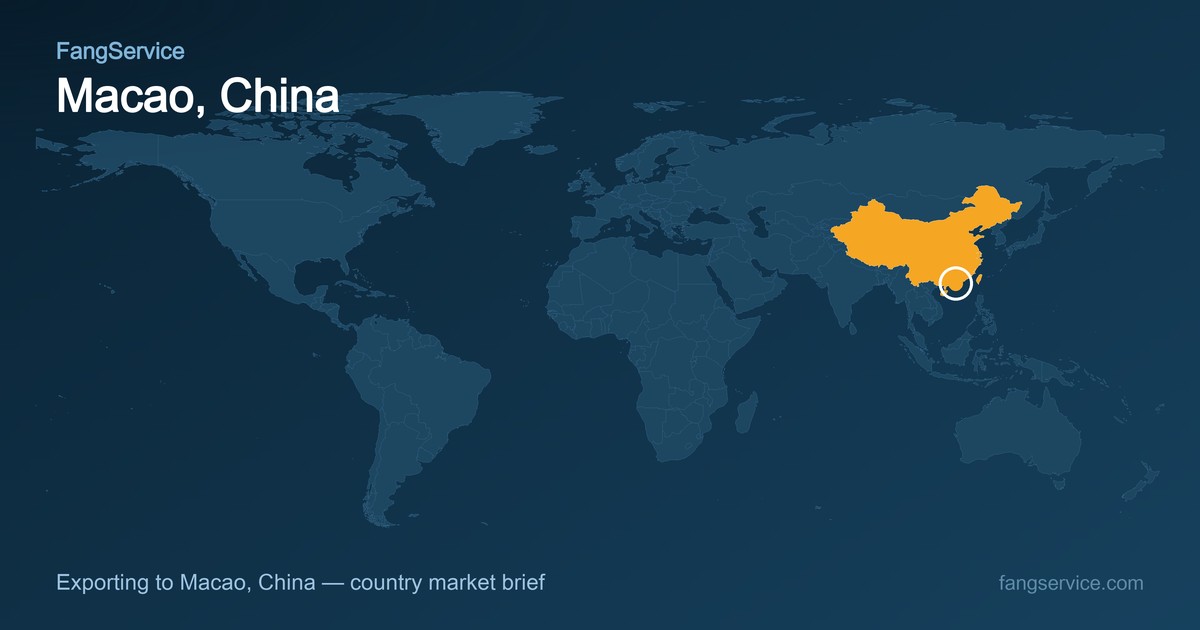
Macao, China on the world map
A very small, service-dominated economy whose goods imports are almost entirely consumption, hotel and construction supply for the gaming and tourism sector. There is no customs duty on general goods and no VAT, so the border is not the obstacle — the obstacle is volume. Macao is realistically worth pursuing only through a Hong Kong or mainland distributor that already serves it, or as part of a wider Greater China agreement.
Best fitHotel, hospitality and construction supply via a regional distributor
Poor fitStandalone industrial or component programmes
Certification
Low
Few mandatory standards for general goods
Tariffs
Zero
Free port; no customs duty on general goods
Payment risk
Low
Well-capitalised buyers; currency pegged to the Hong Kong dollar
Logistics
Good
No deep-sea port; cargo arrives via Hong Kong or Zhuhai
15.5bn USD
Total goods imports (2025)
Small, service-dominated import base
World Bank WDI 2025 vintage
0.3bn USD
Manufacturing value added (2024)
Very small manufacturing base
World Bank WDI 2025 vintage
14%
Manufacturing share of industry
Gaming and tourism economy
World Bank WDI 2025 vintage
~0.0%
Average applied MFN tariff
Free port; no duty on general goods
World Bank WDI (2022)
0%
Import-stage VAT
No VAT
Macao, China has no value-added tax
0.7m
Population (2025)
Small high-income population
World Bank WDI 2025 vintage

1. Your category in Macao, China

We have no verified buyer records for Macao, China in our directory yet. Tell us what you sell and we will build the list for your category.

2. Entry gate

Macao, China is a free port with no customs duty on general goods and no value-added tax. The compliance surface is narrow: product-safety and food safety rules apply to the categories that have them, and a few product types — alcohol, tobacco, pharmaceuticals — need a licence. The real constraint is that the market is tiny, so orders are small and the distribution channel is almost always intermediated.

RequirementStatusWhat it involvesLead timeCostLast verified
Consumer and food safety requirementsCategory-specificConsumer goods and food are subject to the relevant safety and hygiene requirements, and imported food is subject to inspection. Confirm the applicable scheme for your product with the importer.PendingPendingPending
Specific import licensingCategory-specificThere is no general import licence. Licences or authorisations apply to specific categories — notably alcohol, tobacco, pharmaceuticals and a number of controlled goods. Ordinary industrial and electrical goods are not licensed.PendingPendingPending
Importer of recordAlways appliesAny registered local business can act as importer. Because volumes are small, the importer is usually a distributor serving hotels, casinos, retail or construction rather than an industrial buyer.PendingPendingPending
Tariff (MFN)Always appliesAverage applied MFN tariff around 0.0%; the rate depends on the HS line and must be confirmed line by line at HS-code level.—On customs valuePending
Tariff (preference)Not applicableNot applicable in the usual sense: Macao, China is a free port and levies no customs duty on general goods, so there is no tariff to prefer. Duty applies only to a short list of commodities.——Pending
VATNot applicableThere is no VAT on imports. Duty applies only to a short list of commodities. For general goods the landed cost is the goods plus freight and insurance, with no import-stage tax to recover.—0%Pending
LabellingCategory-specificThere is no general labelling requirement. Where rules apply — mainly food and certain consumer goods — labels normally carry Chinese and Portuguese or English text.Pending—Pending
There is nothing hard to clear here; the difficulty is scale. Approach Macao, China as an extension of a Hong Kong or mainland agreement rather than as a market to be opened on its own, and expect the purchasing decision to sit with a distributor, not with the hotel or casino that finally uses the goods.

Certification, tariff and clearance figures change. Every row above carries a verification date, and the current requirement is confirmed with your nominated local agent before each shipment.

3. Buyers and channel partners

Leading buyers and channel partners

We have not yet completed verification of channel partners in Macao, China. Rather than list companies we cannot stand behind, this block stays empty. The Buyer Directory is expanded market by market, and Macao, China is on the list — write to us and we will share what we hold offline.

How to use this list: do not mass-mail. Macao, China is best treated as an extension of a Hong Kong or mainland agreement rather than a market to be opened on its own. Approach distributors that already serve hotels, casinos and contractors, and expect the order sizes to be small and the channel to be long-standing.

4. Demand and import profile

Select your HS code and this block shows the import performance of your own category in Macao, China — not the country's macro numbers.

Import size & growth

Example: imports of this category run at a double-digit share of the market's total and are growing faster than overall imports.

Example values · to be replaced with OEC / WITS data for your HS line

Source-country mix

Example: China is the largest source, ahead of regional and EU suppliers.

Example values · to be replaced with OEC / WITS data for your HS line

Price band

Example: the mid price band is where Chinese supply competes; the low band is held by regional producers.

Example values · to be replaced with customs / trade data

What we can supply to this market

These are the lines we have found the strongest fit for Macao, China. Specifications are on the product pages; tell us your application and we will confirm the model.

PV inverters — Grid-tie and hybrid storage inverters, IP65, WiFi monitoring — supplied for grid-code and conformity programmes Specifications
Portable power stations — 800–3500 W LiFePO4 units, 1–3 kWh — for outdoor, marine and backup demand Specifications
Power-loss regulating equipment — Three-phase, parallel-connected, 10–20% energy saving — for commercial and industrial sites Specifications
Battery and PV test instruments — Test and measurement lines for installation, commissioning and service — the accessory market that follows every certified install Specifications

5. Landed-cost calculator

A static table cannot persuade anyone. Enter your own numbers and see the landed cost. Duty rate and freight are editable so you can test scenarios.

Your shipment

Estimated landed cost

Goods value (FOB)—
Freight and insurance—
Customs value (CIF)—
Import duty—
VAT 0% (on CIF + duty)—
Clearance and local charges—
Certification (amortised)—
Landed cost—
Unit landed cost: — per unit. Duty rate is editable because the exact rate depends on your HS line — confirm it before quoting.

Illustrative calculation only. It excludes anti-dumping duty, excise, port storage and any category-specific surcharge. Confirm the duty rate and local charges with your forwarder before making a commitment.

6. Logistics and customs

No deep-sea container port. Cargo normally arrives via Hong Kong (sea or air, then by road or fast ferry) or overland from Zhuhai across the border at Gongbei
Because almost everything is transhipped, total transit is a function of the Hong Kong or Zhuhai leg rather than of the ocean voyage
Clearance is quick for general goods; the practical constraint is the small consignment size and the limited number of carriers serving the territory
Common hold-ups: food and pharmaceutical consignments without the right authorisation, and hotel or construction deliveries that must be scheduled to the site rather than to the port
Typhoon season (roughly July to September) can suspend ferry and road links for a day or two at short notice

Clearance-day figures change with congestion and policy; treat as indicative and confirm before quoting.

7. Payment, currency and tax

Dominant method: T/T; letters of credit are used for larger construction or hotel supply contracts
Payment discipline is good and buyers are generally well capitalised, but order values are small, so the administrative cost per order matters
Invoicing in HKD or USD is standard; the local currency is pegged to the Hong Kong dollar, which is itself pegged to the US dollar
For hotel and casino supply, payment terms are often tied to the project or procurement cycle rather than to a standard credit period
There is no import VAT to recover, so the landed cost is clean and easy to quote

8. Localisation and communication

These are the details nobody tells you, and one mistake can cost you a customer.

Time zone
GMT+8
No time difference from Beijing
Working week
Mon–Fri
Lunar New Year closes business for several days
Preferred channel
Email + local distributor
Almost all purchasing runs through a distributor already serving the territory
Business language
Chinese / Portuguese / English
English and Chinese are both workable in commercial dealings
Label language
Chinese and Portuguese or English (where rules apply)
Mainly food and certain consumer goods
Units
Metric
No conversion issue
The end user and the buyer are almost never the same organisation. Hotels, casinos and construction contractors buy through distributors, and those distributors buy small quantities and expect to be treated as the customer. Going around them to the end user usually ends the relationship rather than winning the order.

9. Risks and timing

Low
Payment — Buyers are generally well capitalised and payment discipline is good. The residual risk is administrative rather than monetary, because order values are small.
Medium
Volume — The market is small and concentrated in gaming, tourism and construction. A single contract can be material, and its loss can remove most of your volume for the year.
Medium
Channel — Almost all purchasing is intermediated by Hong Kong or local distributors, so your price and your brand are largely in someone else's hands.
Low
Policy — The free-port regime is stable. The main variable is the health of the tourism and gaming sector, which drives most of the goods demand.

Frequently asked questions

Do I pay import duty?

No, for general goods. Macao, China is a free port and levies no customs duty except on a short list of commodities.

Is there VAT or GST on imports?

No. There is no value-added tax, so the landed cost is the goods plus freight and insurance with no import-stage tax to recover.

Do I need an import licence?

Not in general. Licences or authorisations apply to specific categories such as alcohol, tobacco and pharmaceuticals. Ordinary industrial and electrical goods are not licensed.

Can I sell directly to a hotel or casino?

In practice almost all purchasing runs through a distributor already serving the territory. Working through that distributor is normally faster and more durable than trying to sell around it.

How do the goods get there?

There is no deep-sea port. Cargo normally arrives through Hong Kong by sea or air and then moves by road or fast ferry, or comes overland from Zhuhai across the Gongbei border.

How do I get paid?

T/T is dominant, with letters of credit for larger construction or hotel supply contracts. Payment discipline is good, but order values are small, so keep the administrative cost per order low.

Tell us what you want to sell into Macao, China

Send your product, target quantity and destination port. We check the entry requirements, match potential buyers and work out the landed cost. We reply within one business day (GMT+8 business hours).

Enquiry form

The more specific you are, the faster and more accurate our answer