Article
October 26, 2026
The fear is not irrational. One buyer put it this way in a procurement forum: if the part is going to be commercialised, it can show up on a marketplace before the prototype comes back. Others said they had declined to send drawings overseas at all because of the IP risk. Those are buyer-reported views rather than verified incidents, and the useful response is not to argue with them.
An NDA is the standard answer, and it is a partial one. It is worth being precise about which part it covers, because four of the measures that actually reduce risk cost nothing, take an afternoon, and are skipped by most buyers.
This article separates what a confidentiality agreement does from what buyers assume it does, sets out seven measures against what each one actually stops, and ends with the five clauses worth insisting on and one test worth applying to any supplier — including us.
What an NDA Actually Does
It creates a contractual claim. That is more than nothing and less than protection.
Concretely, a signed NDA does four things. It makes the counterparty's organisation aware, because a document that binds a company has to pass through someone who can bind it. It gives you a basis to terminate the relationship, to demand return or destruction of the material, and to claim damages. In some jurisdictions it supports an application for an injunction. And it creates a record that a later dispute can be built on.
What it does not do is prevent copying. No signed document has ever stopped a person who intended to copy. It also does not bind a third party who never signed it — and the third party is usually where the part reappears.
The enforcement question deserves a straight answer rather than a reassurance. In China a well-drafted NDA is enforceable in principle; both contract law and anti-unfair-competition law provide routes. What makes it weak in practice is not the law but the arithmetic: cross-border evidence gathering, translation and notarisation, a local lawyer, and two or three years, set against a part that may be worth a few thousand dollars. Most buyers, given that number, decide not to sue. A supplier who knows that also knows the agreement is unlikely to be enforced.
Which leads to the honest conclusion: an NDA is a screening tool, not insurance. Its main value is that a supplier who will not sign a reasonable one has told you something before you have sent anything at all.
Seven Measures, and What Each One Actually Stops
Read the table by its last two columns. Four of the seven cost nothing and can be done this afternoon; the two that cost something are the two that work on the supplier rather than on the document.
| Measure | What it stops | What it does not stop | Effort |
|---|---|---|---|
| Bilateral NDA with a named governing law and arbitration seat | A supplier using the file outside your project, on the record | Copying that leaves no paper trail, and a third party who never signed it | Low |
| Split the drawing — send only the features that must be made | A supplier understanding the whole product from one part | A supplier reverse-engineering the part itself | Medium |
| Send STEP or IGES, not native CAD | The design history, feature tree, parameters and assembly links embedded in the file | The geometry itself | Low |
| Strip the title block | Your customer's name, the end product, the project name | The part geometry | Low |
| Written tooling ownership | A tool walking away, and a supplier quoting your part to your competitor | A supplier making a similar part on its own tooling | Low |
| Staged release — quote from a simplified drawing, full drawing after PO | The full drawing circulating among suppliers who never win the order | Anything that happens after the purchase order | Low |
| Supplier selection — who asks about tolerance and function | Most of the risk, before it starts | Nothing, once the file has been sent | Medium |
Used together, they cover most of the realistic exposure. Used alone, the NDA covers the smallest part of it — which is why the buyers who rely on it exclusively tend to be the ones who get surprised.
What Actually Leaks, and It Is Usually Not the Drawing
The file you email is rarely the leak. In rough order of frequency, what leaks is:
- The RFQ forwarded to a trading partner or a second factory, “just to check the price”.
- The drawing left in a messaging group with thirty members in it.
- The assembly PDF sent “for context”, which contains the entire product rather than one part.
- The title block, which names your customer and therefore your customer's market.
- A near-identical part on a marketplace that was never your design at all.
That last one is worth pausing on. A good deal of what buyers describe as IP theft is a supplier making a similar part for someone else, using know-how rather than your file — and the know-how was in the process, not in the drawing. This matters because it changes what you are protecting: geometry, process know-how, the end application and the customer relationship are four different assets, and they need four different measures. An NDA covers the first weakly and the other three barely at all.
The practical consequence is to control distribution rather than only the document. One contact at the supplier, one channel, watermarked PDFs carrying the recipient's name, no native files, and a note of who received what and when.
A Drawing Package That Is Safe to Send
Send: a STEP or IGES of the part alone, not the assembly; a 2D PDF with dimensions, tolerances, datums, surface finish, material and heat treatment; the quantity, the intended process and the inspection requirement; and a project code name instead of the end product.
Do not send unless it is genuinely needed: native CAD, because a SolidWorks or Inventor file carries the feature tree and often the assembly links; the full assembly, the bill of materials or the general arrangement drawing; and your customer's name, which belongs on your purchase order and not on a drawing that travels.
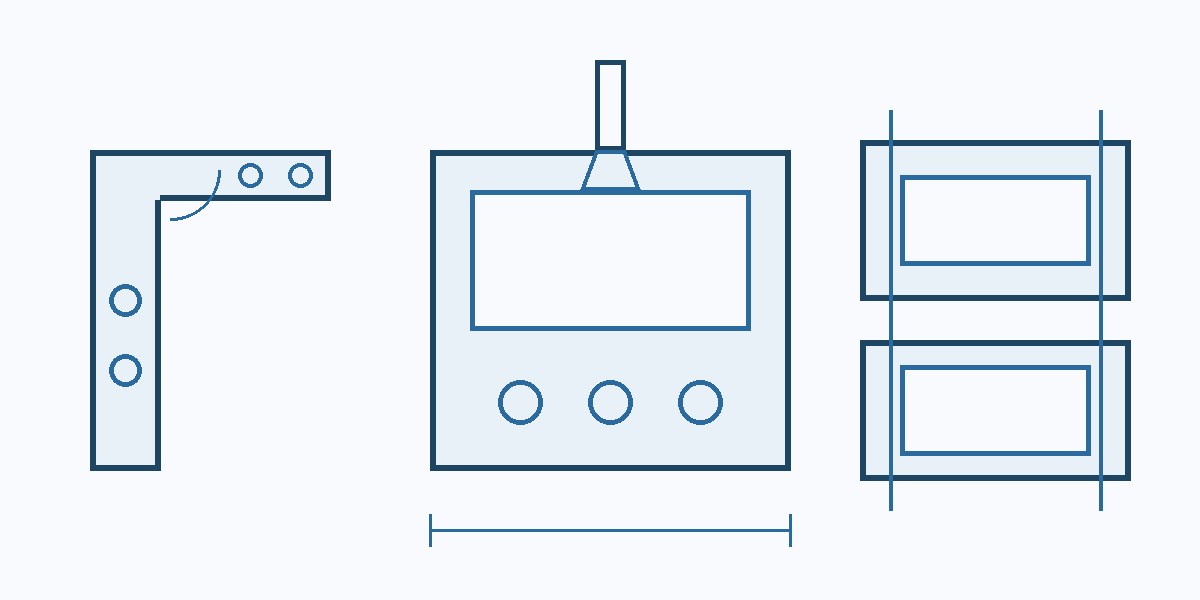
If a supplier cannot quote from a STEP and a dimensioned PDF, that is itself information — the request is a completely normal one, and a factory that needs the native file to price a turned part is telling you something about its engineering depth.
For reference, the formats we accept are STEP, IGES, DWG, DXF and PDF, or a physical sample for reverse engineering. None of those requires you to send a native CAD file.
Five NDA Clauses Worth Insisting On
Most NDAs are copied from a template and are too vague to use. Five clauses are worth arguing about:
- A definition that covers the right things. Drawings, models, samples, tooling, the fact that the project exists, and the identity of the end customer — not just “technical information”.
- A quantity limitation. No manufacture beyond the ordered quantity, with over-runs and scrap addressed explicitly. In manufacturing this is the clause that matters most in practice, because an over-run of five hundred pieces sold on is the most common real loss, and a purpose-limitation clause alone does not always catch it.
- No subcontracting without written consent, and if consent is given, the subcontractor signs the same terms.
- Return or destruction on request, with written confirmation, including copies and backups.
- Governing law, arbitration seat, survival period and who pays — plus injunctive relief. An agreement with no forum named is a document that is expensive to use.
One detail that gets missed more often than any of the five: check that the company name on the signature block is the company that will invoice you. An NDA signed by a trading company does not bind a factory, and in this industry those are frequently different legal entities. Ask which entity will appear on the invoice, and have the same one sign.
What We Do, and the Test We Expect You to Apply
Our product page states that drawings are covered by an NDA and used only for your project. Treat that as a claim to be tested rather than a reassurance, and test it the same way with us as with anyone else: ask for the NDA text before you send anything. A supplier whose answer to “can I see the agreement” is “no need, we are trustworthy” has answered the question.
What we will not claim is that a signed document lets anyone police a factory. What we can do is put the obligations in writing, name who signs, and tell you which legal entity is doing the work — our own operation combines order handling in Shenzhen with production at a factory in Huizhou, and you should ask which entity appears on the signature block and on the invoice, and whether they are the same.
What nobody can do is guarantee that a signed agreement will be enforced across two legal systems at a cost that makes sense for a part worth a few thousand dollars. A supplier who promises that is selling reassurance rather than protection, and reassurance is the one thing you cannot put in a purchase order.
Ask for the NDA before you send the drawing
Drawings, material and quantity are enough to quote. Ask for the agreement text first — it is a reasonable request, and the answer tells you as much as the document does.
Request a quoteSee the precision component capabilities
STEP, IGES, DWG, DXF, PDF or a physical sample. Sheet metal, CNC machining and moulds in one project window, ±0.05 mm routine, first articles in 1–2 weeks.
View specifications