Article
March 9, 2022
At 45°C ambient, capacity must be derated, dust blocks cooling and corrodes terminals, and a single site visit can take two days — the reality from Timbuktu and Gao in Mali to Agadez in Niger, Chad and northern Sudan. Maintainability is not an add-on; it is the first selection constraint.
What Is Left of Rated Capacity at 45°C
At inland sites around Timbuktu and Gao in Mali, Agadez in Niger, Chad, northern Sudan and Mauritania, summer ambient holds above 45°C and cabinet interiors run hotter still. The nameplate capacity figure distorts — and by more than most people expect. Lead-acid capacity falls as temperature falls and rises as temperature rises, so at 45°C a given battery actually delivers more capacity than at 25°C, a point routinely misunderstood. The real problem is not less capacity but shorter life: float life at 45°C is roughly a quarter of that at 25°C. At high-temperature sites, then, capacity is not the constraint — life is. Conversely, a string sized for four hours at 25°C will carry the site for about four and a half hours in its first two years at 45°C, then fall below three hours from year three as ageing takes over. That overshoot-then-shortfall curve is the classic high-temperature backup failure mode.
Three Ways Dust Does Damage
Dust affects a battery system slowly but cumulatively, along three concrete paths. First, blocked cooling: cabinet intake filters and battery enclosure louvres clog within weeks during dust season, adding another 5°C to 8°C inside — and since every 10°C halves life, that alone takes another cut. Second, terminal corrosion: dust is not conductive in itself, but once damp it adheres to terminals and straps forming a saline electrolyte film, and under the condensation cycle driven by day-night temperature swings, post corrosion accelerates markedly, contact resistance rises and terminals heat under high-rate discharge. Third, tracking and shorting: conductive dust accumulating between positive and negative terminals forms a tracking path in humid weather, and in severe cases causes surface leakage or fire. The responses are respectively: replace filters with washable metal mesh on a monthly route, fit insulating terminal covers and apply anti-corrosion grease, and blow down with dry compressed air rather than washing with water.
Why Front Terminals Save Labour Hours
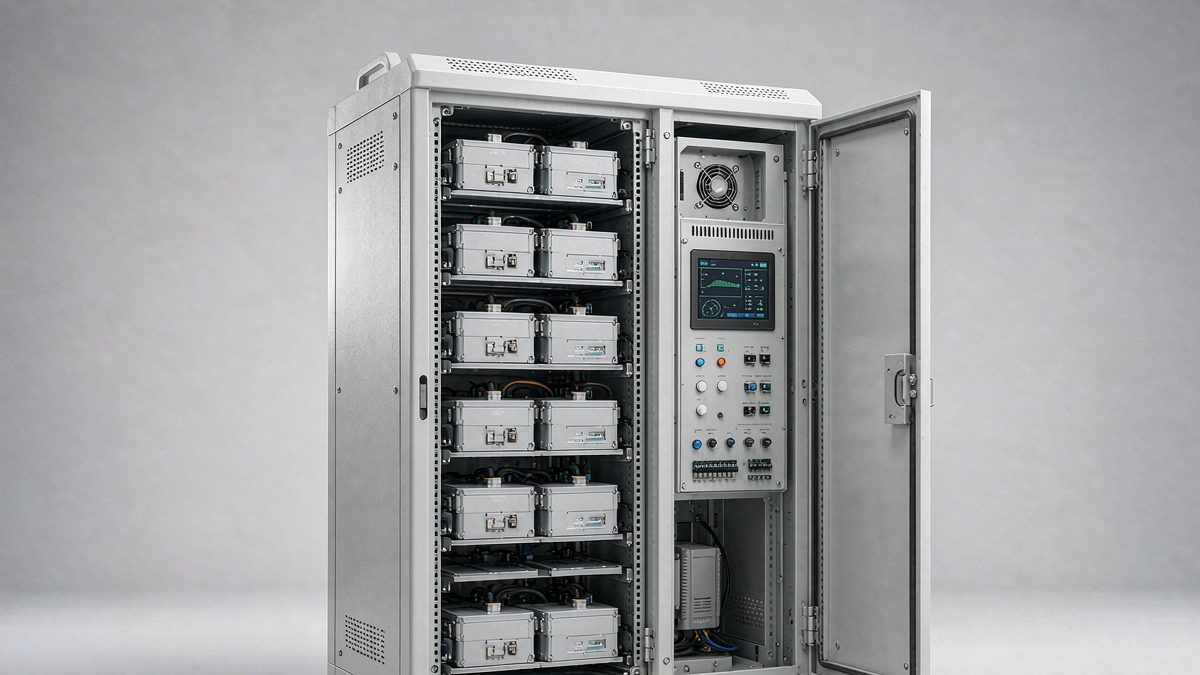
At sites that take two days to reach, labour hours are cost, and battery construction decides those hours directly. Conventional batteries have top terminals; once installed in a cabinet the terminals face upward behind a shelf or cable tray, so checking one terminal means removing a shelf and moving cables — over forty minutes to inspect a four-unit string. Front-terminal design (6-FMX series, 50–200Ah, nine models) puts both terminals on the front face, so batteries can sit side by side against the cabinet wall and inspection requires removing nothing; the same four-unit inspection drops under ten minutes. Replacement differs even more: top-terminal units must be lifted out before wiring, while front-terminal units allow straps to be removed and refitted in place. Front terminals also save cabinet depth, which leaves more convection gap — returning to the temperature problem. In Africa's high-cost maintenance environment, the annual labour saving from this structural difference usually exceeds the price difference between the batteries.
Maintenance-Free Is Not Inspection-Free
The phrase 'maintenance-free battery' is deeply misleading in an African context. It means no distilled water topping-up, not no inspection. Precisely because the cell cannot be opened to check electrolyte, external indicators matter more. An inspection list suited to high-cost site access has five items: first, monobloc internal resistance measured with a portable tester, flagging anything more than 20% from the string mean; second, monobloc voltage at rest, flagging anything more than 0.05V from the mean; third, terminal temperature measured with an infrared gun immediately after discharge, where a 5°C differential indicates abnormal contact resistance; fourth, visual condition, focusing on case swelling, terminal corrosion and fluid traces; fifth, environment, recording cabinet peak temperature and filter blockage. All five take under fifteen minutes on site but cut the probability of a sudden whole-string failure substantially. The key is to tie inspection interval to access cost: where a visit takes two days, do not set a quarterly cycle — set a six-monthly cycle with all five items mandatory. Lower frequency is acceptable; skipped items are not.
Driving MTTR from 72 Hours to 24
In the Sahel a 72-hour MTTR is normal, and reaching 24 requires four levers at once. First, spares location: pre-position complete strings in regional warehouses within six hours' drive, at 3% to 5% of the site count, with a complete model range. Second, replaceability: choose monoblocs within two-person handling weight — front-terminal 12V units are mostly 30 to 65kg — and avoid large 2V cells needing lifting gear or four-person carries; connect with bolts, not welded joints. Third, pre-configuration: match, charge and label complete strings in the warehouse so the field swap is a straight replacement with no matching or initial charging on site. Fourth, remote early warning: monitor monobloc voltage and internal resistance and raise an alarm two to four weeks before failure, converting corrective callouts into planned work — the single largest MTTR improvement, because most callouts stop being emergencies. All four deliver 24 hours; the first three alone typically reach only 48.
A Cabinet Retrofit Checklist for Hot Sites
Choose the right battery and leave the cabinet alone, and half the benefit disappears. A directly actionable checklist for hot sites has six items. First, add an insulated canopy or double roof to block direct insolation — the largest temperature reduction in the Sahel and the cheapest measure. Second, move the air intake to the shaded face and fit washable metal dust mesh with more area than the original design, since airflow must be maintained even when partly blocked. Third, fit a thermostatic fan set to start at 40°C and stop at 35°C, with a 5°C differential or the fan short-cycles and its life collapses. Fourth, raise the battery bank at least 300mm off the cabinet floor to escape the heat pocket and any monsoon standing water. Fifth, apply a light-coloured reflective coating inside the cabinet to reduce solar absorption — particularly effective on metal enclosures. Sixth, fit a baffle above the battery bank so the fan does not blow directly onto the cells and create a local temperature differential; this is often overlooked, yet a differential makes monoblocs age at different rates until the whole string is limited by the weakest unit. Together these six typically drop cabinet temperature by 8°C to 12°C, which doubles life. The cost is far below one string replacement and should be standard practice at hot sites, not an option. View Telecom Backup Power Selection
Need a Custom Solution?
Tell us your project scenario and requirements, and we will match the right solution and provide a quote within 24 hours.
Get a Free QuoteView Telecom Base Station Backup Power Products
Nine series, sixty models: 12V front-terminal (6-FMX, 50–200Ah, 12-year), high-temperature (6-FMXH, 55°C with double float life), gel (6-XFMJ, 15-year), deep-cycle (FTC, 1,500+ cycles), 2V power station (GFD / GFM, 200–3,000Ah, 15-year), high-rate (GFMHR, 500W–2,700W at 15 min), lead-carbon (LLC, 300–1,000Ah, 20-year, 4–5× PSoC cycling) and 48V LiFePO4 (SDA10, 50–200Ah, continuous 1C). Intelligent BMS with SOC/SOH monitoring and four protection classes, with optional dry contacts for existing site monitoring systems.
Explore Backup Power Selection and Pricing →