Article
June 16, 2020
At remote sites in Maluku, Palawan and Sabah, delivered diesel can cost several times the pump price. Once transport, handling, losses, theft and generator maintenance are included, the cost per kWh of load served per year produces a counter-intuitive answer — and shows exactly where lead-carbon and lithium each win.
What a Diesel Genset Really Costs on an Island
Remote sites in Indonesia's Maluku, Papua and Sulawesi outer islands, in Palawan and the Mindanao highlands of the Philippines, and in the interior of Sabah and Sarawak share one property: the grid either does not exist or arrives for only a few hours a day. Backup at these sites is not backup at all — it is the primary supply, and the diesel generator runs eight to twenty hours a day. At that point the price of a battery string is irrelevant; what matters is cost per kWh of load served per year. Delivered diesel cost has five components: the pump price, freight to the jetty, second-leg transport from jetty to site (boat, motorcycle, human porterage), storage losses and theft, and generator maintenance and overhaul amortised by running hour. At hill sites requiring porterage, the second leg alone can be one to two times the fuel price; add servicing every 500 hours and overhaul every 5,000 hours and the diesel path typically costs two to four times urban diesel generation per kWh. And that number moves with fuel price and logistics capacity — variables no operator controls.
Converting Battery Price into Cost per kWh-Year
Battery comparisons are meaningless unless converted to a common basis. The correct calculation sums purchase price, the number of replacements across the service life, transport and labour for each replacement, and the energy cost of charge/discharge losses, then divides by rated capacity × usable depth of discharge × years of cycling, giving cost per kWh-year. Take a 48V/100Ah string rated 4.8 kWh: at 50% depth of discharge only 2.4 kWh is usable, and on a daily cycle that 2.4 kWh must carry 365 days. If the string is replaced every three years, all three purchases count — not just the first. This single step exposes two common errors: treating rated capacity as usable capacity, and treating design life as cycle life. Under daily cycling, a battery rated twelve years of float service may deliver only 300 to 500 cycles — exhausted within a year.
Why Lead-Carbon Suits Daily Cycling
Under one charge-discharge cycle a day with long periods at partial state of charge, ordinary AGM fails conspicuously: the negative plate sulphates rapidly in PSoC, forming dense lead sulphate crystals that normal charge voltage cannot reduce, so capacity is permanently lost. Lead-carbon addresses this directly by adding activated carbon to the negative plate, creating a combined capacitive and electrochemical storage mechanism so charge current preferentially takes the capacitive path and sulphate does not build up on the plate surface. The LLC series (300–1,000Ah, six models, 2V) uses lead-carbon capacitance technology with four to five times the cycle life of conventional products in PSoC duty, roughly 30% better charge acceptance, and a twenty-year design life. For island sites the 30% faster charging may matter more than cycle life: the generator runs only a few hours a day, the charging window is short, and charge acceptance determines how much energy is recovered each day — and therefore whether the site survives until the next generating period.
When Lithium Is the Right Answer
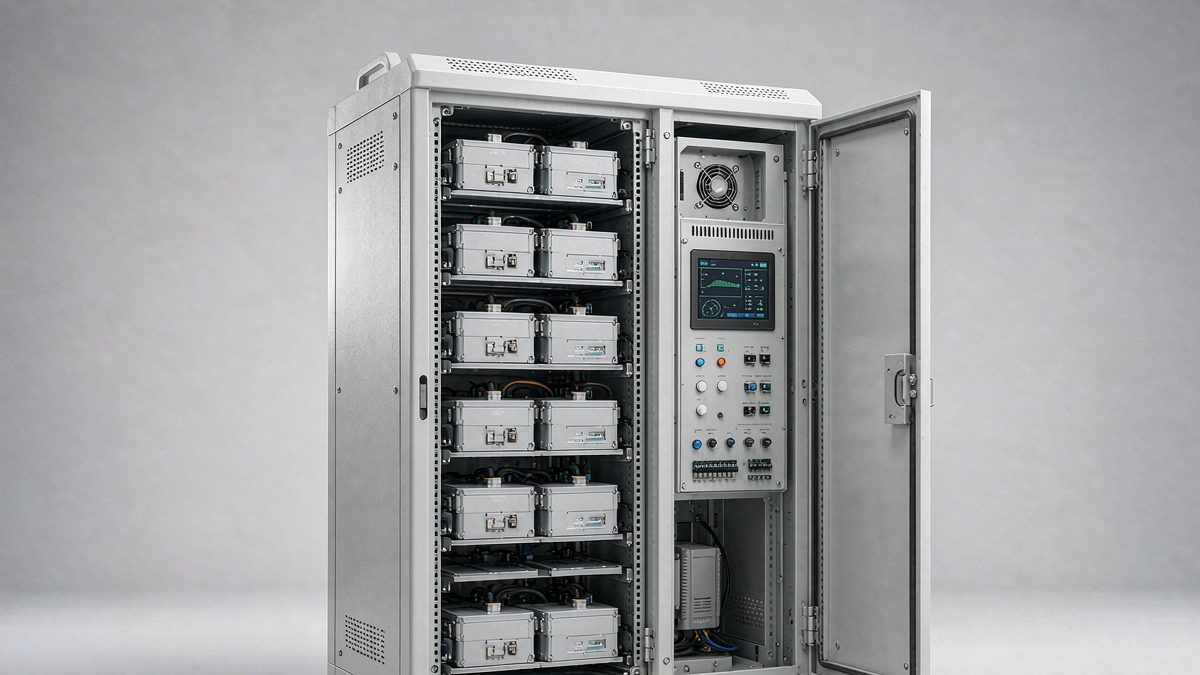
Lithium is not an upgraded lead-carbon; it is a different applicability boundary. The 48V LiFePO4 systems (SDA10 series, 50–200Ah, four models) offer continuous 1C discharge and very long cycle life at one third to one half the volume and weight of equivalent lead-acid capacity. Three situations favour lithium: sites with constrained space or floor loading, such as small cabinets mounted on a tower platform where lead-acid simply will not fit; applications needing high instantaneous current, where 1C means a 100Ah string can deliver 100A continuously, which lead-acid cannot do in the same volume; and sites with a service life beyond ten years and very high transport cost, where the high first cost is offset by two avoided replacements. Conversely, at sites where ambient temperature stays above 45°C with no thermal management, lithium's life advantage erodes sharply and lead-carbon's heat tolerance is more dependable. The test is not which technology is more advanced, but which of the three — temperature profile, cycling frequency, transport cost — is most expensive at that site.

Three Hybrid Topologies
Island sites almost never run on a single source, and topology choice determines overall efficiency. The first is diesel-primary with battery buffer: the generator runs against load and the battery covers changeover gaps and overnight shutdown. Lowest retrofit cost, suited to small loads where fuel supply is workable but the grid is absent entirely. The second is solar plus battery plus diesel standby: PV serves load and charges the battery by day, the battery discharges at night, and diesel starts only after prolonged overcast or battery depletion. Diesel running hours can fall below two a day with the largest fuel saving, but it needs adequate array area and dust protection. The third is a fully renewable solar plus battery plus small wind configuration, viable only where annual wind speed is stable and load is small — of limited practicality in the Southeast Asian monsoon belt. What all three share is that the battery moves from standby to daily cycling prime mover, so cycle life, charge acceptance and high-temperature behaviour decide system economics — not generator efficiency.
Sizing the Battery in a Hybrid System
Battery capacity in a hybrid system must be sized to the longest period without recharge, not to backup hours — and the two answers can differ by a factor of two. The calculation has four steps. First, daily energy consumption: load in kW × 24 hours, noting that day and night loads usually differ and should be calculated separately then summed. Second, the longest consecutive overcast period: two to three days in the Southeast Asian monsoon belt, with three being conservative; East African highlands show more variable cloud cover, so add a day. Third, usable capacity requirement = daily consumption × overcast days ÷ allowable depth of discharge, taking DOD at 70%. Fourth, apply temperature and ageing correction, typically ×1.15 to ×1.25. For a site consuming 24 kWh a day, three days of autonomy at 70% DOD needs about 103 kWh usable, or roughly 124 kWh after a 20% correction. That figure is usually far larger than a 'four-hour backup' calculation produces, because the two answer different questions: one is what to do when the sun does not appear for three days, the other is what to do during a four-hour outage. At an off-grid site only the first is meaningful. Undersize it and the system collapses in the first overcast spell — usually at the moment communications matter most; oversize it and the payback stretches until the project fails at the budget committee. Take the conservative overcast figure; do not cut capacity to two days to save capital. View Telecom Backup Power Selection
Need a Custom Solution?
Tell us your project scenario and requirements, and we will match the right solution and provide a quote within 24 hours.
Get a Free QuoteView Telecom Base Station Backup Power Products
Nine series, sixty models: 12V front-terminal (6-FMX, 50–200Ah, 12-year), high-temperature (6-FMXH, 55°C with double float life), gel (6-XFMJ, 15-year), deep-cycle (FTC, 1,500+ cycles), 2V power station (GFD / GFM, 200–3,000Ah, 15-year), high-rate (GFMHR, 500W–2,700W at 15 min), lead-carbon (LLC, 300–1,000Ah, 20-year, 4–5× PSoC cycling) and 48V LiFePO4 (SDA10, 50–200Ah, continuous 1C). Intelligent BMS with SOC/SOH monitoring and four protection classes, with optional dry contacts for existing site monitoring systems.
Explore Backup Power Selection and Pricing →