Article
November 15, 2016
In outdoor cabinets from Jakarta to Manila, backup batteries routinely fail in three to four years against a twelve-year rating. This article breaks down the real ageing path in hot, humid climates — water loss under float, grid corrosion, rising internal resistance — and the selection and installation combination that restores an eight-year replacement cycle.
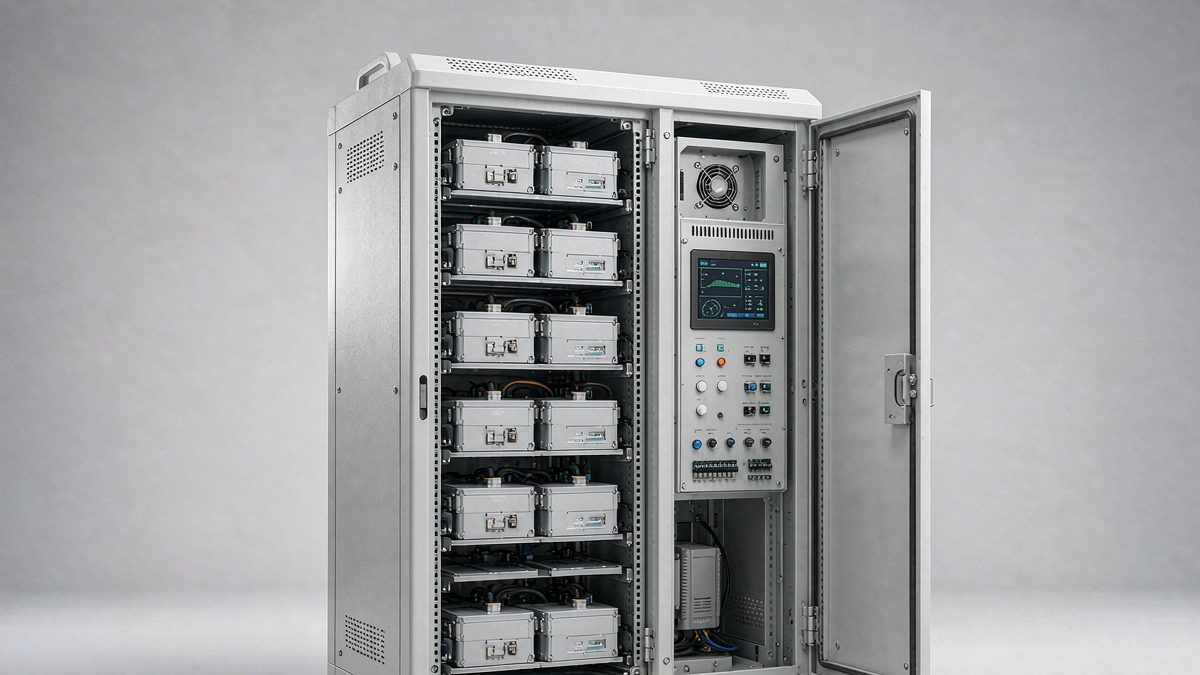
It Is 15°C Hotter Inside the Cabinet
In Jakarta, Kuala Lumpur, Bangkok, Ho Chi Minh City and Manila, operator maintenance records show a recurring pattern: backup batteries in outdoor integrated cabinets serve only three to four years, against a rated design life of ten to twelve years. The gap is usually blamed on battery quality. Yet install the same batteries in a shaded, ventilated indoor equipment room and life immediately returns to eight years or more. The problem is not the battery — it is the cabinet. A south-facing outdoor cabinet with no shade and no forced ventilation can run more than 15°C above ambient at midday. With an annual average of 28°C and a midday ambient of 35°C, the interior reaches 50°C. Battery life ratings are referenced to 25°C. And this is not a two-hour daily peak: it runs from ten in the morning to four in the afternoon, almost every day of the year. Tropical cities have no winter, so the battery never gets a season to recover.
How Heat Eats Capacity, Step by Step
Lead-acid ageing follows a well-established rule of thumb: for every 10°C rise in operating temperature, chemical reaction rates roughly double and float life roughly halves. The rule holds well between 25°C and 45°C. Applied here, a battery rated twelve years at 25°C gives six years at 35°C and three years at 45°C — which matches the three-to-four years in the records exactly. There are three specific failure paths. The first is water loss: at high temperature float current rises, oxygen evolution at the positive grid accelerates, water is electrolysed and escapes as gas, and the starved-electrolyte VRLA design has no spare acid to replace it — so capacity falls and internal resistance climbs. The second is grid corrosion: corrosion rate roughly doubles per 10°C, the positive grid thickens, active material sheds, and the damage is irreversible. The third is thermal runaway risk: higher resistance means more heat during charging, and more heat means higher resistance again — a positive feedback loop inside a poorly ventilated cabinet. Humidity attacks from the other side. With relative humidity persistently above 90%, terminal creepage, post corrosion and strap oxidation all raise contact resistance, and the extra heat from those joints accelerates ageing further.
Three Technologies at 45°C
Under identical conditions, different technology routes give completely different answers — which is exactly where selection should focus. The standard 12V front-terminal series (6-FMX, 50–200Ah, nine models) is rated twelve years at 25°C and will realistically deliver three to four years in a 45°C cabinet; its value is a compact footprint and front terminals that make in-cabinet maintenance easy, so it suits temperature-controlled sites. The high-temperature series (6-FMXH, 100–170Ah, three models) is built for this duty: rated for continuous operation at 55°C with a double float-life design, giving roughly twice the float life of the standard series at the same temperature — the most direct answer for a tropical cabinet. The gel series (6-XFMJ, 90–150Ah, four models) uses a special gel electrolyte to suppress acid stratification and is rated for fifteen years; its advantage in heat is a markedly lower water-loss rate than AGM, at the cost of slightly weaker charge acceptance and lower high-rate discharge performance. No route is universally better: if cabinet temperature can be held below 35°C the standard series is sufficient; if it cannot, the high-temperature or gel series is the correct answer.
What Installation Changes Alone Can Recover
Before replacing batteries, do four things that cost almost nothing and typically drop cabinet temperature by 8 to 12°C — effectively doubling battery life. First, shade: add an insulated canopy or a solar panel above the cabinet to cut direct insolation, the single highest-return measure. Second, orientation: keep the intake away from the west face; in Southeast Asia, afternoon west sun produces a more persistent heat load than south exposure. Third, ventilation: fit a thermostatically controlled fan set to start at 35°C and stop at 30°C, so hot air is expelled before midday rather than after the cabinet reaches 45°C. Fourth, elevation and spacing: raise the battery bank above the lower third of the cabinet to escape the heat pocket and the monsoon flood line, and keep at least 10mm of convection gap between monoblocs instead of packing them tightly to save space. After these four steps, many sites need no new batteries at all — only a new installation method.
A Checklist to Move from Three Years to Eight
Here is a checklist you can take straight to a site survey. First, measure cabinet temperature: place a data logger in the middle of the battery bank, record 72 hours continuously, and take both the midday peak and the daily mean — this is the input to every later decision. Second, recompute life from the measured temperature: take 25°C as the reference, halve for every 10°C above it, and derive an expected service life to align with the procurement cycle. Third, select by temperature: standard front-terminal below a 35°C peak, high-temperature or gel between 35 and 50°C, and above 50°C fix the thermal problem first, because no battery will survive it. Fourth, write temperature into acceptance criteria: a new site should not exceed a 40°C midday peak inside the cabinet — this clause determines replacement cost eight years out more than any battery datasheet figure. Fifth, add internal resistance to the annual inspection: replace any monobloc deviating more than 20% from the string mean, and never let one failed battery drag down the whole string. Do these five things and the move from three years to eight is achievable.
Writing Temperature into the Specification
The five steps above are operational, but the decisive sentence sits on the procurement side. Most tender documents describe temperature as 'suitable for tropical climates' or 'operating range -20°C to 50°C' — wording that can neither be accepted nor enforced, because a battery does operate at 50°C; it simply does not survive three years there. Three clauses make it verifiable. First, specify cabinet interior temperature rather than ambient, and require bidders to warrant life at 45°C inside the cabinet instead of under 25°C laboratory conditions. Second, require float-life data at 25°C, 35°C and 45°C, and write into the contract that where measured cabinet temperature exceeds the warranted value, the warranty period is recalculated by halving for every 10°C — making the thermal risk explicit. Third, list 'high-temperature type' as a separate technical option so bidders can respond with a high-temperature product, rather than forcing standard and high-temperature products into one price band; the latter guarantees that bidders compete by quoting standard product, and three-year batteries are what get delivered. These three clauses may add 15% to 25% to unit price, but they cut replacements over eight years from two to one, and with two site visits of labour and transport removed the total cost falls. It is a conclusion that recurs across tropical markets: paying more is often buying right. View Telecom Backup Power Selection
Need a Custom Solution?
Tell us your project scenario and requirements, and we will match the right solution and provide a quote within 24 hours.
Get a Free QuoteView Telecom Base Station Backup Power Products
Nine series, sixty models: 12V front-terminal (6-FMX, 50–200Ah, 12-year), high-temperature (6-FMXH, 55°C with double float life), gel (6-XFMJ, 15-year), deep-cycle (FTC, 1,500+ cycles), 2V power station (GFD / GFM, 200–3,000Ah, 15-year), high-rate (GFMHR, 500W–2,700W at 15 min), lead-carbon (LLC, 300–1,000Ah, 20-year, 4–5× PSoC cycling) and 48V LiFePO4 (SDA10, 50–200Ah, continuous 1C). Intelligent BMS with SOC/SOH monitoring and four protection classes, with optional dry contacts for existing site monitoring systems.
Explore Backup Power Selection and Pricing →