Article
May 14, 2024
The scrap value of a battery string is a fraction of its replacement cost, yet it is enough to make the risk worthwhile. Operators across South Africa, Nigeria, Kenya, Zimbabwe, Zambia and Mozambique absorb heavy annual losses. This article sets out a three-layer combination of physical protection, technical lockout and procedural design — and where spending should stop.
The Thief's Arithmetic
Across South Africa, Nigeria, Kenya, Zimbabwe, Zambia and Mozambique, base station battery and diesel theft is a chronically underestimated line in operating cost. Designing protection starts with understanding the other party's arithmetic: scrap value × portability ÷ risk. A 48V/100Ah lead-acid string weighs about 130kg and, broken down for scrap lead and plastic, may fetch only 3% to 8% of the new price. Diesel is more direct — a 200-litre drum sells at black market rates with almost no traceability. So the preference order is usually diesel first, because it is easy to carry, easy to sell and easy to launder; a complete battery string second, because there is an established buyer network; individual monoblocs third, because dismantling needs tools. This explains a counter-intuitive observation: many sites have cabinet locks and perimeter fencing yet still lose diesel daily, because the fuel line and tank are not inside the cabinet at all. Protection must cover every monetisable asset, not just the battery enclosure.
Four Layers of Physical Protection
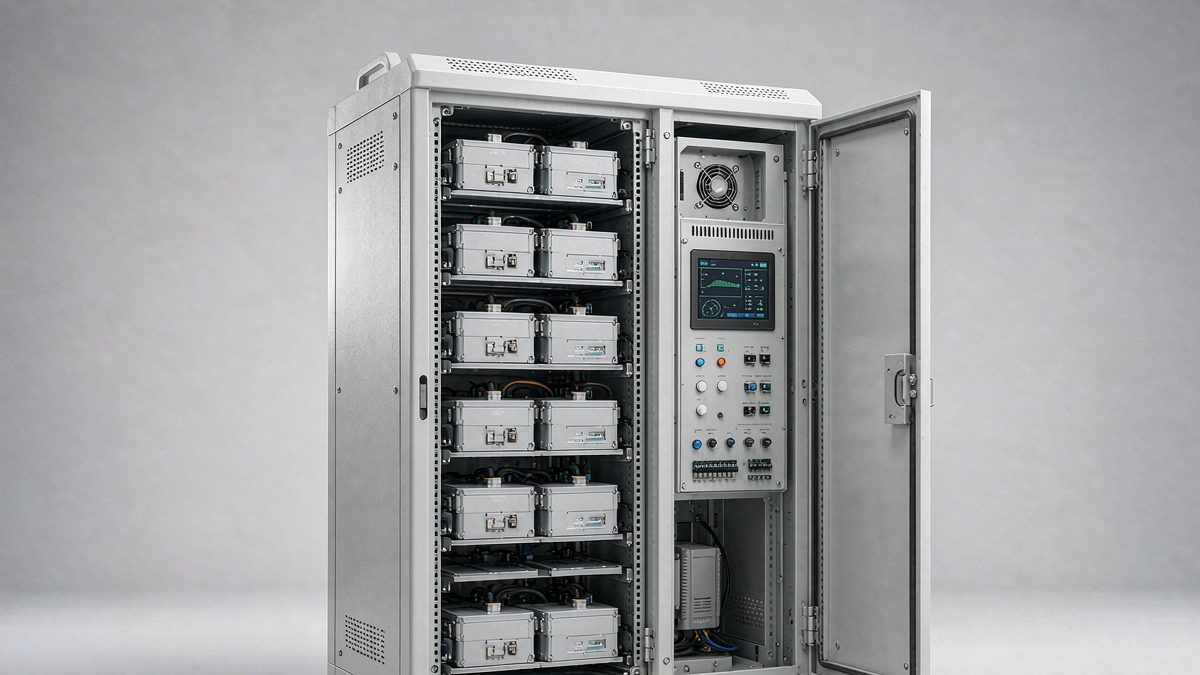
Physical protection must be layered, because a single layer only raises the threshold without changing the payoff. Layer one is being seen: site lighting, fencing and visible cameras — even dummy ones — raise the probability of detection. Layer two is entry: drill- and pry-resistant multi-point cabinet locks, anti-cut mesh on perimeter gates, and concrete plinths at critical sites to prevent whole-unit removal. Layer three is dismantling: bolt the string to the cabinet with anti-theft brackets, use fasteners requiring special tools for connecting straps, or conceal straps behind a locked compartment. This layer is the most effective, because it directly extends the time a thief needs. Layer four is removal: fit shock and door sensors reporting immediately, tied to a guard or police response. Cost rises across the four, but benefit is not linear: experience shows layer three — extending dismantling time — has the best return, because it turns a five-minute job into a thirty-minute one, and most thefts are completed within ten minutes.
Making a Stolen Battery Useless
Technical lockout complements physical measures by removing value once the asset leaves site. Three approaches work. The first is serialisation and traceability: laser-mark every battery at manufacture, register it in the operator's asset system, and share the serial list with local scrap lead buyers so they refuse material without provenance. This has worked in parts of Zambia and Kenya precisely because it cuts the resale channel. The second is chemical marking: add a UV-detectable tracer to the electrolyte or case so police can confirm origin with a lamp. The third is electronic lockout: on lithium systems such as the SDA10 series, the BMS can enforce a geofence or pairing check so the battery refuses to discharge once removed from the authorised site, or runs only at reduced power. This is particularly effective for lithium because the BMS is inherently controllable; it does not apply to lead-acid, which relies on the first two. Of the three, serialisation is cheapest and fastest to show results, and should be a mandatory contract requirement for all new battery purchases.
Procedure and Insurance
Beyond technology and hardware, procedure and insurance are the backstop layers. Three procedural steps matter. First, make asset registration real: every battery's serial number, installation date, site and custodian must be retrievable in the system, or a theft cannot even be reported properly. Second, establish an abnormal-offline process: when monitoring shows a sudden voltage drop or loss of communication at a site, someone must confirm on site within 24 hours — many thefts are discovered two days after the battery has gone. Third, build relationships with local communities; at rural sites, community vigilance is often more effective than any technology and cheaper too. On insurance, two traps matter: most property policies carry deductibles or exclusions for unattended sites, so base station assets must be explicitly listed; and claims require an asset register and inspection records, without which settlement is heavily discounted. Procedure and insurance depend on each other — it is not either-or.

Where Protection Spending Should Stop
More protection is not better; spend until marginal benefit equals marginal cost. The calculation is simple. Let L be the expected annual loss at a site (historical loss × probability), C the annualised cost of a measure (capital ÷ service life + annual maintenance), and r the proportion of loss the measure prevents. The measure is worth doing when L × r > C. For example, a site robbed twice in three years at eight battery strings per incident has an expected annual loss of about 5.3 strings; if a measure costs the equivalent of one string a year and prevents 60% of loss, it returns 3.2 strings annually and is clearly worth it. At a site that has never been robbed, the same measure does not pay — which is exactly why protection should be tiered rather than uniform. In practice, tier sites by historical incidents — zero, one, two or more — with basic, enhanced and maximum protection respectively, concentrating spend where risk is genuinely high.
The First 72 Hours: Reporting, Claiming, Recovering
The seventy-two hours after a theft decide how much is recovered and how much is paid out, and most operators' procedures fail exactly there. Step one is scene preservation: do not rush to reinstall batteries and restore service. Photograph and video the scene, record the serial numbers of missing units, and leave pry marks on the cabinet intact — this is the primary evidence for both the police report and the claim, and once the scene is cleaned it cannot be recreated. Step two is reporting: take the asset register, serial list and photographs to the local police station, file a case and obtain a report receipt; without the receipt insurers normally will not proceed. Step three is notifying the insurer: most policies require notice within 24 to 48 hours of discovery and may decline late claims — a requirement belonging in the operations manual, not discovered by reading the policy afterwards. Step four is notifying the resale channel: circulate the stolen serial list to local scrap lead buyers and second-hand battery traders. This step usually recovers more than police investigation, because it acts directly on the fence. Step five is restoring service: use a temporary string or a mobile generator rather than leaving the site offline while waiting for a settlement. Of the five, the ones most often skipped are the first and the fourth — and those two determine recovery rate and settlement amount. View Telecom Backup Power Selection
Need a Custom Solution?
Tell us your project scenario and requirements, and we will match the right solution and provide a quote within 24 hours.
Get a Free QuoteView Telecom Base Station Backup Power Products
Nine series, sixty models: 12V front-terminal (6-FMX, 50–200Ah, 12-year), high-temperature (6-FMXH, 55°C with double float life), gel (6-XFMJ, 15-year), deep-cycle (FTC, 1,500+ cycles), 2V power station (GFD / GFM, 200–3,000Ah, 15-year), high-rate (GFMHR, 500W–2,700W at 15 min), lead-carbon (LLC, 300–1,000Ah, 20-year, 4–5× PSoC cycling) and 48V LiFePO4 (SDA10, 50–200Ah, continuous 1C). Intelligent BMS with SOC/SOH monitoring and four protection classes, with optional dry contacts for existing site monitoring systems.
Explore Backup Power Selection and Pricing →