Article
January 21, 2025
Under tower leasing, backup power moves from a self-built asset to a service delivered against an SLA. How to write availability, MTTR and capacity assurance into a contract, how BMS state-of-charge and state-of-health data support billing and penalties, where to place spares warehouses, and why this operating data is the tower company's most valuable second asset.
From Self-Build to Lease: What Changed in the KPIs
Tower companies such as Mitratel and TBIG in Indonesia, Edotco and PhilTower in the Philippines, Edotco in Malaysia, and operators in Vietnam and Thailand have moved a large share of base stations from self-build and self-maintain to leased tower and leased power. The effect on backup power is badly underrated. Under self-build, backup is a fixed asset measured on asset availability and repair turnaround; under leasing it is a service measured on site availability and service credits. The incentives point in opposite directions: the first favours spending little and stretching life, the second favours buying the highest availability at the lowest whole-life cost. The more substantive change is the boundary of responsibility — how much battery, how often to replace, how fast to attend a fault were internal decisions under self-build and must now be written into a contract. Where they are left vague, the first widespread outage starts an argument.
Three Clauses an SLA Needs
A backup power SLA needs at least three clauses that can be measured and arbitrated. The first is availability, and it cannot simply say 99.5% — numerator and denominator must be defined. The denominator is the number of grid outages in the period exceeding N minutes; the numerator is how many of those were successfully carried until the grid returned or the generator started. The value of N matters enormously: five minutes versus thirty minutes can move the calculated availability by several percentage points. The second is MTTR, which must distinguish remotely recoverable faults from faults requiring a site visit — the first measured in hours, the second in days — and must state whether the clock starts at alarm generation or work order dispatch. The third is capacity assurance, which cannot merely guarantee that a battery string exists but that end-of-life residual capacity is at least X% of rating, normally 80%. That clause must be tied to periodic capacity testing or it cannot be verified. Beyond the three, force majeure must be agreed in advance: typhoons, flooding and cut roads are a certainty in Southeast Asia and the treatment of resulting delay has to be settled before the season, not after.
Without Remote Monitoring, an SLA Cannot Be Measured
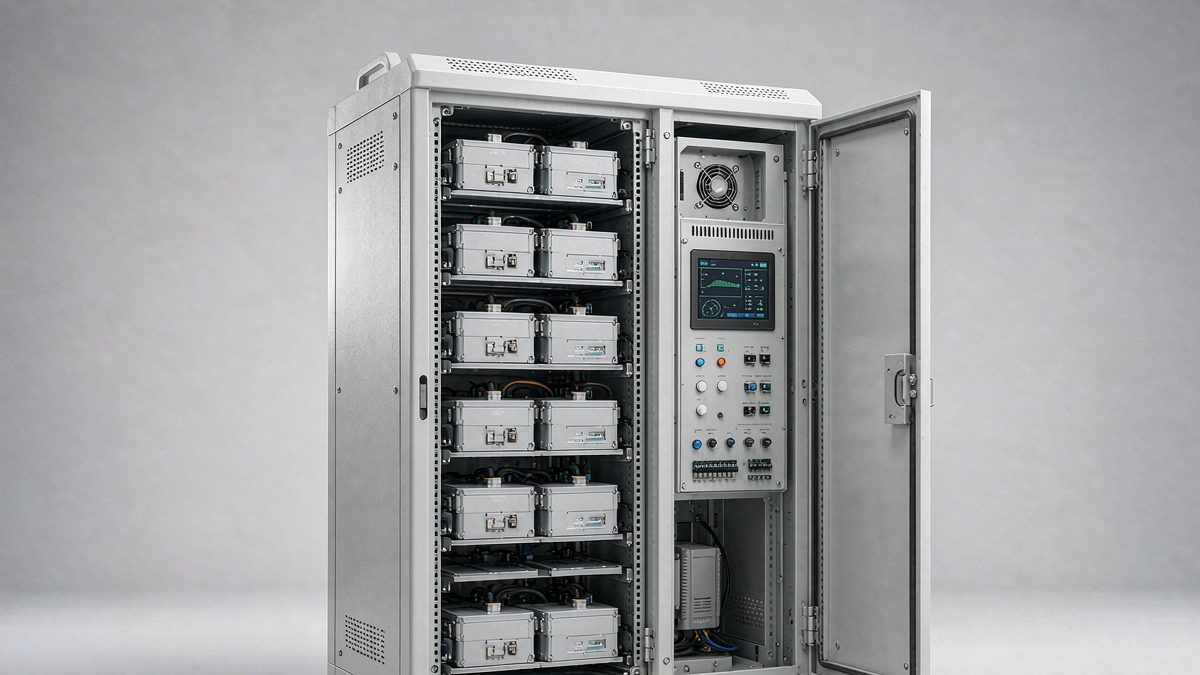
An SLA presupposes measurement, and measurement presupposes data. Conventional lead-acid strings report only total voltage, and a string can show normal total voltage while one monobloc lags — invisible on the total, fatal to the whole string during an outage. Delivering an SLA therefore requires per-monobloc and string-level monitoring: cell voltage, string current, ambient temperature, and critically state of charge and state of health. The intelligent BMS option provides accurate SOC and SOH monitoring with over-discharge, over-charge, over-current and temperature protection, plus optional dry contacts for integration with an existing site monitoring system. The dry contact point matters in practice: tower companies inherit existing sites whose monitoring platforms were built by the operator or a third party, and new batteries must integrate with that platform rather than require a second one. Sampling interval belongs in the contract too — cell voltage at least every ten minutes and SOC change events reported in real time — otherwise the discharge curve during an outage cannot be reconstructed and responsibility cannot be assigned.
Spares Warehouses and MTTR
MTTR is not about crews driving fast; it is about spares being close. When a tower company takes over a region, the first task is to draw the four-hour drive coverage circle and place the warehouse at its geometric centre — not in the provincial capital. What sits inside matters equally: complete battery strings, connecting straps, terminal covers, insulated tools, a capacity tester, and enough temporary generator interface cable. As a rule of thumb, a regional warehouse covering 300 to 500 sites needs complete strings equal to 3% to 5% of the site count, but the model range must be complete: 12V front-terminal (6-FMX, 50–200Ah, nine models) covers most outdoor cabinets and the 2V range (GFM, 200–3,000Ah) covers equipment-room sites; hold both or the field ends up cannibalising one site to fix another. Transport is the other overlooked element: island regions need a shipping contingency and mountain regions a motorcycle or porterage contingency, and both should be written into the MTTR definition rather than negotiated after the fact.
The Second Life of the Data Asset
Once digitised, a tower company accumulates data nobody else has: actual load profile at every site, the duration and frequency of every outage, the decay rate of every battery string, and temperature and humidity by region. That data is worth far more than backup power alone. First, it enables repricing: the same SLA costs less in a low-outage region and more in a high-outage one, and data-driven differentiation beats a flat rate. Second, it enables capacity optimisation: flag sites with abnormal decay and intervene early rather than discovering the failure at the worst moment. Third, it feeds back into network planning — which sites need more backup, which should go solar, is all in the data. This is precisely why an operator buying batteries should make open data interfaces a mandatory technical requirement rather than accepting it as a supplier add-on. Without the data, an SLA can only ever be backed by manual inspection.
Four Clauses That Cause the Most Disputes
Disputes between tower company and operator over a backup power SLA cluster in four places, and writing them clearly in advance prevents most of them. First, how an outage is counted: if power returns briefly and fails again, is that one outage or two? Industry practice treats a gap longer than five minutes as two events, but it must be written into the contract, or each side will count to its own advantage. Second, whether a generator start counts as backup success: if the contract guarantees only that the battery carries the site until the grid returns, a generator start does not count; if it guarantees an uninterrupted site, it does. The cost difference between the two definitions is large — quotations can differ by more than 30% — so the definition must be explicit. Third, responsibility for capacity fade: when capacity falls short, is that a product defect, excessive site temperature, or load beyond design? Agree that an accepted third party performs the capacity test while recording temperature and load during the test, or the discussion goes nowhere. Fourth, availability exemption during retrofit: replacing a string necessarily leaves the site briefly without backup, and whether that period counts in the availability denominator, and whether it is pro-rated, must be settled in advance. What these four share is that none is a technical question — all are questions of definition, and definitions can only be settled before signature. After signature, any concession means admitting the point was not thought through. View Telecom Backup Power Selection
Need a Custom Solution?
Tell us your project scenario and requirements, and we will match the right solution and provide a quote within 24 hours.
Get a Free QuoteView Telecom Base Station Backup Power Products
Nine series, sixty models: 12V front-terminal (6-FMX, 50–200Ah, 12-year), high-temperature (6-FMXH, 55°C with double float life), gel (6-XFMJ, 15-year), deep-cycle (FTC, 1,500+ cycles), 2V power station (GFD / GFM, 200–3,000Ah, 15-year), high-rate (GFMHR, 500W–2,700W at 15 min), lead-carbon (LLC, 300–1,000Ah, 20-year, 4–5× PSoC cycling) and 48V LiFePO4 (SDA10, 50–200Ah, continuous 1C). Intelligent BMS with SOC/SOH monitoring and four protection classes, with optional dry contacts for existing site monitoring systems.
Explore Backup Power Selection and Pricing →