Article
April 7, 2026
Purchase price is only part of TCO. Once replacement count, site visit cost, float energy and residual value are included, a fifteen-year cash flow ranks the three technologies very differently from lowest-price-wins. Includes the eight data points to demand in a tender.
Why Purchase Price Misleads
In tenders across Nigeria, Kenya, South Africa, Egypt, Morocco, Tanzania and Côte d'Ivoire, the most common evaluation method is ranking by price per amp-hour — and that method almost guarantees the wrong choice. It hides three significant costs outside the purchase price. The first is replacement count: a twelve-year VRLA needs one replacement inside a fifteen-year horizon, a twenty-year lead-carbon needs none, and if the price gap is smaller than the full cost of one replacement, lead-carbon is cheaper. The second is site visit cost: where a site takes two days to reach, one replacement's transport and labour can equal 30% to 60% of the battery price, and none of that appears in the quotation. The third is energy: batteries draw self-discharge and float current, and float power differs by multiples between technologies — at diesel-powered off-grid sites that loss converts directly into fuel. Add the three and the lowest unit price becomes the highest total cost.
The Five Pockets of TCO
Break TCO into five pockets, each calculated over fifteen years. Pocket one is capital: battery price, transport, installation, and the associated racks and cabling. Pocket two is replacement: derive the number of replacements from design life, and count battery price, transport, labour and disposal each time. Pocket three is operations: inspection frequency × cost per visit, plus capacity testing. Pocket four is energy: float power in watts × 8,760 hours × 15 years × local electricity price, converted to diesel generation cost at off-grid sites. Pocket five is residual value and recycling: scrap lead recovery offsets part of the cost for lead-acid, while lithium recycling infrastructure is still thin and is mostly charged as hazardous waste disposal in the region. Beyond the five, list outage cost separately — service credits payable when backup fails are real cash under an SLA.
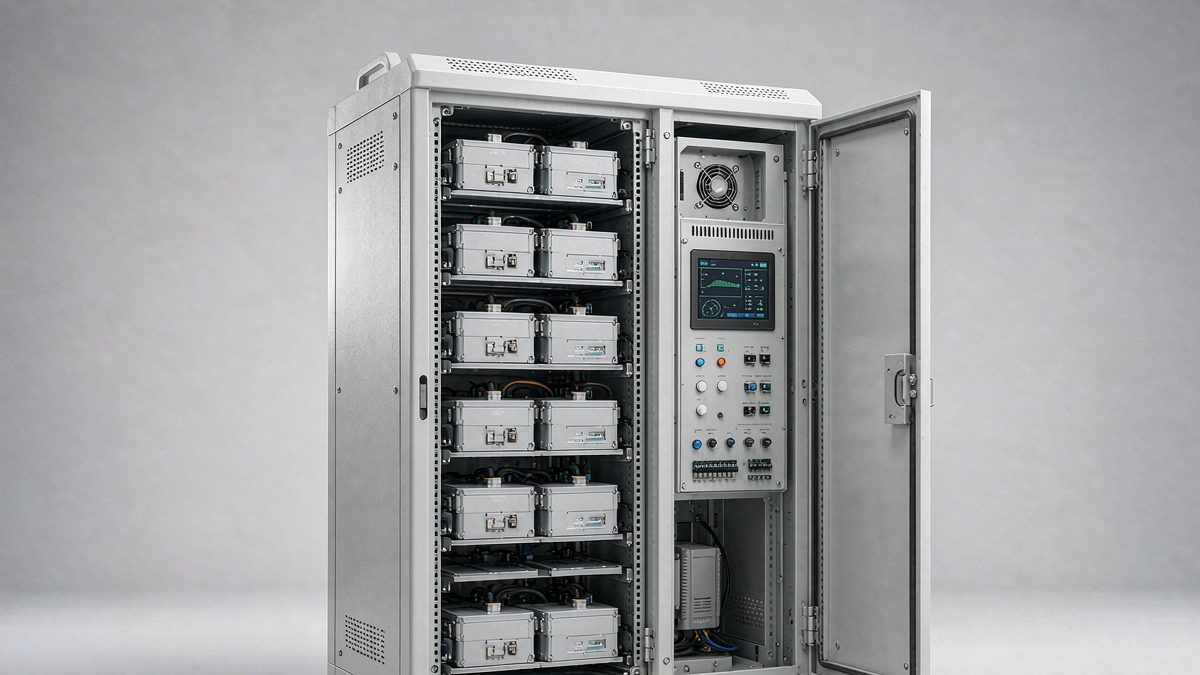
Fifteen-Year Cash Flow for Three Technologies
Put the three technologies in one fifteen-year cash flow and the ranking becomes clear, and not what intuition suggests. Standard VRLA (twelve-year design life, such as the 6-FMX series at 50–200Ah) spends at year zero and again at year twelve, with quarterly inspection in between and moderate float power. Its strength is the lowest capital cost, a mature supply chain and local availability — suited to constrained budgets and short leases. Lead-carbon (twenty-year design life, such as the LLC series at 300–1,000Ah, six models) costs more at year zero, needs no replacement within fifteen years, offers four to five times the cycle life of conventional product and 30% better charge acceptance; where outages are frequent its advantage compounds, because it saves diesel as well as replacements. LiFePO4 (such as the SDA10 series at 50–200Ah with continuous 1C discharge) has the highest capital cost but one third to one half the volume and weight of lead-acid, so in high-transport-cost regions avoiding two shipments is itself a material saving. Which ranks first over fifteen years depends on local site visit cost, diesel price and outage frequency — those three variables decide the winner.
Exchange Rates and Financing
Two financial variables cannot be ignored in African TCO analysis. The first is the exchange rate: batteries are usually priced in dollars while revenue is in local currency, so depreciation makes a replacement five years out far more expensive than today's rate implies. The Nigerian naira, Egyptian pound and Kenyan shilling have all seen large swings in recent years, which means long-life technologies are systematically undervalued — their core benefit is avoiding a future dollar outflow. TCO should be run as a sensitivity analysis under local-currency depreciation scenarios, not at spot rates alone. The second is financing cost: where local interest rates are high, the cost of capital on initial spend is amplified, which makes low-capital options look more attractive. The two variables pull in opposite directions, so the right approach is not to pick a side but to treat depreciation and financing rate as two inputs, compute TCO across combinations, and decide against the company's actual capital structure.

Eight Data Points to Demand in a Tender
For TCO to be calculated accurately, eight data points must be demanded in the tender; miss one and the calculation fails. First, cycle life, with the test standard and depth of discharge stated — 'twelve-year design life' alone is insufficient. Second, float life versus temperature, with data at least at 25°C, 35°C and 45°C. Third, charge acceptance, meaning maximum charge current and time from 50% to 100%. Fourth, float power in watts, for the energy calculation. Fifth, capacity retention curve, to derive usable capacity at end of life. Sixth, weight and dimensions, for transport cost and cabinet layout. Seventh, recycling and disposal arrangements, including take-back channel and cost. Eighth, the specific terms of the warranty, especially the guaranteed capacity percentage and the claims process. All eight belong in the technical specification as mandatory responses rather than reference material — suppliers willing to provide complete data are usually the ones able to deliver on their promises.
Where Each Technology Fits: A Decision Table
Condense the applicability boundaries into a table for direct use at procurement. Standard VRLA (twelve-year design life): suited to sites with grid availability above 95%, controlled temperature, remaining lease under ten years and constrained budget; unsuitable for frequent outages, high temperature or leases beyond fifteen years. Lead-carbon (twenty-year design life): suited to sites at 50% to 80% availability with one or two cycles a day, a limited charging window and high site access cost; unsuitable for very small loads below 500W, where unit cost cannot be amortised. LiFePO4 (ultra-long cycle): suited to sites with constrained space or floor loading, a need for high instantaneous current, leases beyond fifteen years and very high transport cost; unsuitable where ambient temperature persistently exceeds 45°C without thermal management. No technology wins universally — only against a specific duty. To use the table, fill in four site attributes first: availability, temperature, lease term and access cost, then read off the column. If any one of the four cannot be filled in, the groundwork is incomplete, and the right action is to gather data rather than to select. Most wrong TCO answers come not from a wrong formula but from wrong inputs: treat a site with six hours of daily outage as float standby and the most precise model still returns the wrong answer. View Telecom Backup Power Selection
Need a Custom Solution?
Tell us your project scenario and requirements, and we will match the right solution and provide a quote within 24 hours.
Get a Free QuoteView Telecom Base Station Backup Power Products
Nine series, sixty models: 12V front-terminal (6-FMX, 50–200Ah, 12-year), high-temperature (6-FMXH, 55°C with double float life), gel (6-XFMJ, 15-year), deep-cycle (FTC, 1,500+ cycles), 2V power station (GFD / GFM, 200–3,000Ah, 15-year), high-rate (GFMHR, 500W–2,700W at 15 min), lead-carbon (LLC, 300–1,000Ah, 20-year, 4–5× PSoC cycling) and 48V LiFePO4 (SDA10, 50–200Ah, continuous 1C). Intelligent BMS with SOC/SOH monitoring and four protection classes, with optional dry contacts for existing site monitoring systems.
Explore Backup Power Selection and Pricing →